

Some organizations with on-premises EDI/B2B integration believe that cloud modernization means switching to an iPaaS platform. But what if you're satisfied with your current platform? This article explores another path for moving your B2B integration infrastructure to the cloud.
That path is on-premises-to-cloud migration, or simply prem-to-cloud. Prem-to-cloud can deliver cloud benefits without the platform replacement that migrating to iPaaS often requires.
iPaaS options such as Boomi and Cleo Integration Cloud are smart strategic choices for organizations across a wide range of industries or company requirements. You can explore the iPaaS option in our post, What is iPaaS, and is it Time to Adopt It?
At the same time, we also work with organizations that already own a capable EDI/B2B platform. What they want is a path to move away from the hardware, storage, and other components of integration infrastructure.
What they don’t want is to give up the tool they’ve built their businesses on. Or lose the value and utility of their existing investments, processes, and expertise. For customers in this category, prem-to-cloud can be an attractive path to modernization.
What Is Prem-to-Cloud Migration?
Prem-to-cloud migration means moving an existing EDI/B2B integration environment from self-procured and managed infrastructure to a cloud environment.
Think of it this way: the software and related assets remain largely the same, but the environment around it changes. Your team's EDI maps are still in place. Trading partner relationships and business-critical integrations also keep working as before.
What changes is where those workloads are hosted and how the team manages the underlying infrastructure.
While every migration is different, most projects follow a similar pattern. Organizations begin by assessing their current environment and identifying dependencies.
They prepare a cloud environment, then they migrate applications and supporting components. Next, they validate performance and connectivity. Finally, they transition production workloads to the new environment.
Prem-to-cloud migration allows organizations to keep and build on their current EDI/B2B platform investments. At the same time, they can reap the benefits from cloud scalability, resiliency, and operational flexibility.
Why Do Organizations Choose Prem-to-Cloud Migration?
Organizations choose prem-to-cloud for many reasons. In our experience, the top three are:
Strategic continuity: Many companies have invested years in creating integrations. They onboard trading partners, refine business processes, and train staff on a specific EDI/B2B platform. If the platform continues to meet business needs, moving it to modern infrastructure might offer more value than replacing it.
Operational continuity: After migration, many maps and workflows stay the same. Partner setups, monitoring processes, and support procedures often remain unchanged, too. Users and administrators can continue using the existing platform without needing to learn a new one.
Migration simplicity: When organizations focus on infrastructure, they can avoid platform changes. This keeps projects simpler. It also cuts the risk of business disruption.
Aging hardware and data center refresh cycles can cause issues. Security needs and disaster recovery plans also push organizations to rethink where they host their environments.
Moving to the cloud can provide better scalability, resiliency, and flexibility. As well as reducing the need to manage physical infrastructure.
Lastly, sticking with their current platform lets organizations preserve the predictability of maintaining familiar licensing and support models.
How Do I Know if Prem-to-Cloud Is the Right Choice for Our Organization?
The best choice depends on your objectives. If your EDI/B2B platform still meets your needs, prem-to-cloud lets you modernize without the hassle of replacing your platform.
Organizations aiming for a broader integration strategy might find iPaaS makes sense. If they want a cloud-native model or a vendor-managed platform, iPaaS could be a good fit too.
Another option is the hybrid approach. Some organizations move selected workloads to the cloud while keeping other flows on-premises. This allows them to modernize in stages and cut the risk of migration.
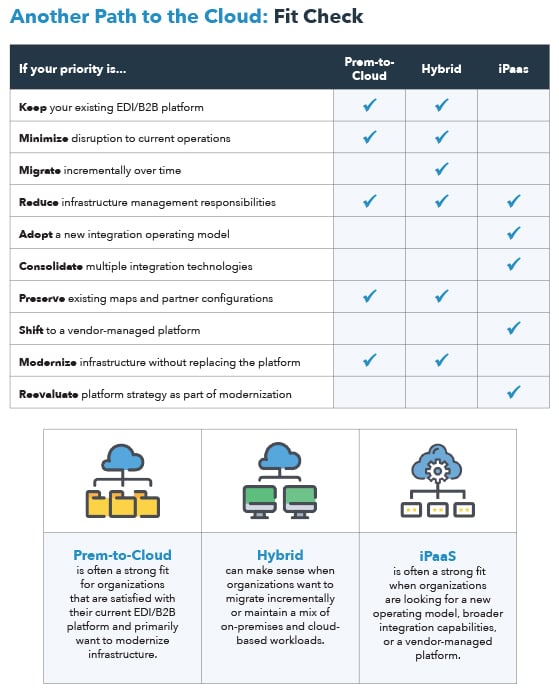
The best path depends on your current situation, your goals, and how much change your organization is ready to handle.
How Can Remedi Support Prem-to-Cloud Migrations?
Every cloud migration begins with understanding what you're trying to accomplish. To help get you get prepared for a smooth transition, try our EDI Cloud Migration Template. Use it to assess your current environment, identify dependencies, and start your migration plan.
If you're looking at options or planning a migration, reach out here. We can show you how our cross-platform experience can help support the right platform and migration path for your organization.
About Us
Remedi helps customers succeed with the platforms they prefer, from IBM, Cleo, Microsoft, 1 EDI Source, SEEBURGER, Boomi, OpenText, and beyond.
FAQs
1. What is on-premises-to-cloud migration?
On-premises-to-cloud or prem-to-cloud migration is the process of moving an existing EDI/B2B platform from self-managed infrastructure to a cloud environment without replacing the platform itself.
2. How is prem-to-cloud different from iPaaS?
On-Premises-to-Cloud migration preserves the existing platform while changing the infrastructure. iPaaS typically involves adopting a cloud-based integration platform and operating model.
3. What stays the same during a prem-to-cloud migration?
The platform, maps, trading partner relationships, integrations, workflows, and business processes often remain largely unchanged.
4. What changes during a prem-to-cloud migration?
The infrastructure changes include servers, storage, networking, hosting, security, and disaster recovery capabilities.
5. Can organizations take a hybrid approach to cloud migration?
Yes. Many organizations choose to migrate incrementally, maintaining a combination of on-premises and cloud-based workloads based on business and technical requirements.