

As integration environments expand, various teams now manage EDI, MFT, APIs, EAI, and related applications. But what works for one department can lead to duplicated effort, inconsistent governance, security exposure, and limited visibility into dependencies across the environment.
Some organizations are responding to issues like SaaS integration sprawl by bringing more of these functions into one portfolio under a single leader. The exact scope varies, but the objective is similar: create greater visibility, consistency, and direction across integration technologies and the teams responsible for them.
This article explains how new integration leaders can assess, prioritize, and resolve gaps across the integration environments they now oversee. If you are one of them, congratulations on your new role.
Whether your title is Director of Integration, Director of Business Information Systems, or Senior Manager of B2B Integration Technology, your main challenge is the same. You must keep a complex integration portfolio running. At the same time, you need to learn about the people, processes, platforms, and dependencies you now oversee.
As you learn the environment, you may begin seeing gaps and constraints across three areas: people and capacity, production, and technology. Examples include:
- Heavy dependence on one or two long-tenured specialists
- Backed-up onboarding queues
- Production support consuming the team’s available capacity
- Failed or invalid transactions
- Undocumented integrations, maps, business rules, exceptions, or partner-specific configurations
Gaps often don't show poor leadership or execution. In fact, teams that can keep up production during hiring freezes, budget cuts, and competing projects are valuable assets. They can adapt to new demands and keep things running smoothly.
What Do New Integration Leaders Need to Do First?
Your first task is not to fix everything or assign responsibility for how each gap developed. Instead, you want to identify the environment’s critical workflows, dependencies, failure points, and risks.
Tools such as our integration architecture template can help you document critical EDI/B2B integration details such as the number of trading partners, integrations including WMS and financial systems, EDI standards, and communication types.
While every leader’s environment will look different, here’s what a general approach to building a practical sequence for improvement might look like:
- Stabilize what cannot wait: active incidents, business-critical workflows, upcoming launches or cutovers, material SLA exposure, and urgent security or compliance concerns.
- Build a working—not necessarily perfect—inventory of platforms, interfaces, partners, owners, dependencies, support arrangements, and single points of failure.
- Listen to the people doing the work. Ask where manual intervention, after-hours effort, tribal knowledge, and informal handoffs are keeping production moving.
- Tell executive stakeholders what you know, what still requires discovery, which risks need containment, and when they will receive a prioritized view.
Organize what you find across three connected categories.
What People and Capacity Issues Could Limit Progress?
The logical place to start is with the team. Naturally, you want to know if they have enough time, shared knowledge, and support to keep production running. But you also want to know if they have the bandwidth to resolve recurring failures, reduce backlogs, and complete needed upgrades.
Is Production Support Stealing Time from Remediation and Planned Projects?
Assess how much time the team spends responding to incidents, reprocessing failed documents, supporting partners, and manually monitoring transactions.
Then determine how much capacity is left for fixing the causes of recurring failures, reducing onboarding backlogs, and completing upgrades or migrations.
The same people often handle both types of work. When production support consumes most of their time, timelines for remediation and modernization projects are likely to keep slipping.
Is Central Knowledge Concentrated and Vulnerable to Departure?
Identify workflows that depend heavily on one or two long-tenured specialists. You also want to flag looming retirements or departures. These events can raise risk. Key details about integrations, maps, business rules, exceptions, and recovery procedures may go with them.
To avoid being left with critical knowledge gaps, you’ll want to prioritize:
- Documentation
- Cross-training
- Knowledge transfer based on business criticality and departure risk
Are Hiring Constraints and Scarce Platform Skills Limiting Your Options?
Getting a handle on your capacity and skills gaps is essential. But be prepared to contend with the factors that have prevented them from being filled.
Many organizations, especially manufacturers and retailers, remain under margin pressure. Culprits include tariffs, higher input costs, and rising transportation expenses.
That pressure leads understandably to spending restrictions like hiring freezes and salary constraints. These factors may compound the difficulty of recruiting specialists for older—but still business-critical—platforms.
You’ll need to distinguish immediate continuity needs from longer-term staffing requirements to determine where internal development, permanent hiring, or consulting and staff augmentation may fit.
Which Production Issues Require Immediate Attention?
Even with these capacity constraints, your main responsibility—early in your tenure and going forward—is straightforward. Keep transactions, transmissions, and messages flowing while reducing recurring failures and manual work.
Doing that means getting a firm grasp of what’s happening across three related areas.
What Failures are Interrupting Operations?
Identify failures affecting time-sensitive business processes across EDI, MFT, EAI, APIs, and application workflows, while distinguishing immediate recovery from root-cause remediation. This matters because delays can trigger steep SLA fines, operational bottlenecks, and supply chain failures.
Which Backlogs Most Affect Customers or Partners?
Review onboarding queues, missed launches, aging defects, chargebacks, SLA failures, and strained relationships. Prioritize the issues with contractual, revenue, retention, or reputational consequences.
The next step is to determine if current monitoring and reporting make those risks visible soon enough for the team to act.
Is Monitoring Producing Noise Rather than Actionable Data?
Monitoring creates noise when it generates alerts without showing which failures affect critical workflows or require immediate action.
Effective monitoring helps the team identify what failed, understand the business impact, and prioritize its response. Tracking recurrence, recovery time, manual touches, and business impact can also show which problems need permanent fixes.
If the necessary tools are not already in place, implement monitoring that can detect failures and send useful alerts. Automated monitoring can reduce manual work and lower the risk of business disruption and financial loss.
What Technology Issues Could Increase Risk or Constrain Growth?
Whether you’ve been in your new role for six days or six months, you don’t want your priorities dictated by crisis. Bringing order to integration sprawl requires a clear view of hidden dependencies, inconsistent standards, and lifecycle pressures.
Are There Undocumented Integrations and Dependencies?
Start by documenting the maps, rules, exceptions, owners, and dependencies tied to critical or failure-prone workflows. Complete documentation can remain a longer-term goal while the team acts on known risks.
Where Do Platforms Overlap and Lifecycle Pressures Converge?
Assess tool overlap, migrations, end-of-support dates, licensing, and scarce skills as related portfolio decisions. Determine which capabilities and dependencies must be preserved before setting vendor-reduction targets.
This helps reduce sprawl without disrupting critical workflows or replacing one form of complexity with another.
Are Inconsistent Governance, Security, and Standards Creating Risk?
Compare how teams handle ownership, testing, deployment, monitoring, access, and retirement. Identify where inconsistent practices, unstable operations, or incomplete inventories create risk and limit safe automation.
Establishing shared standards helps reduce fragmentation and prevents sprawl from continuing.
How Do You Establish Control While Fostering Collaboration?
Start by listening to the team and building a shared view of where processes work—and where people rely on workarounds or extra effort.
Make clear who owns each workflow and decision, when issues should be escalated, and how work moves between integration, application, infrastructure, security, ERP, WMS, and business teams.
Also, avoid trying to standardize everything at once. Start with how teams rank incidents, approve changes, review failures, record ownership, and document critical workflows.
Use incident reviews to learn and prevent repeat problems, not to assign blame. Hold brief, regular check-ins to show progress, surface constraints, and keep teams aligned.
How Do You Move from Priorities to an Actionable Integration Plan?
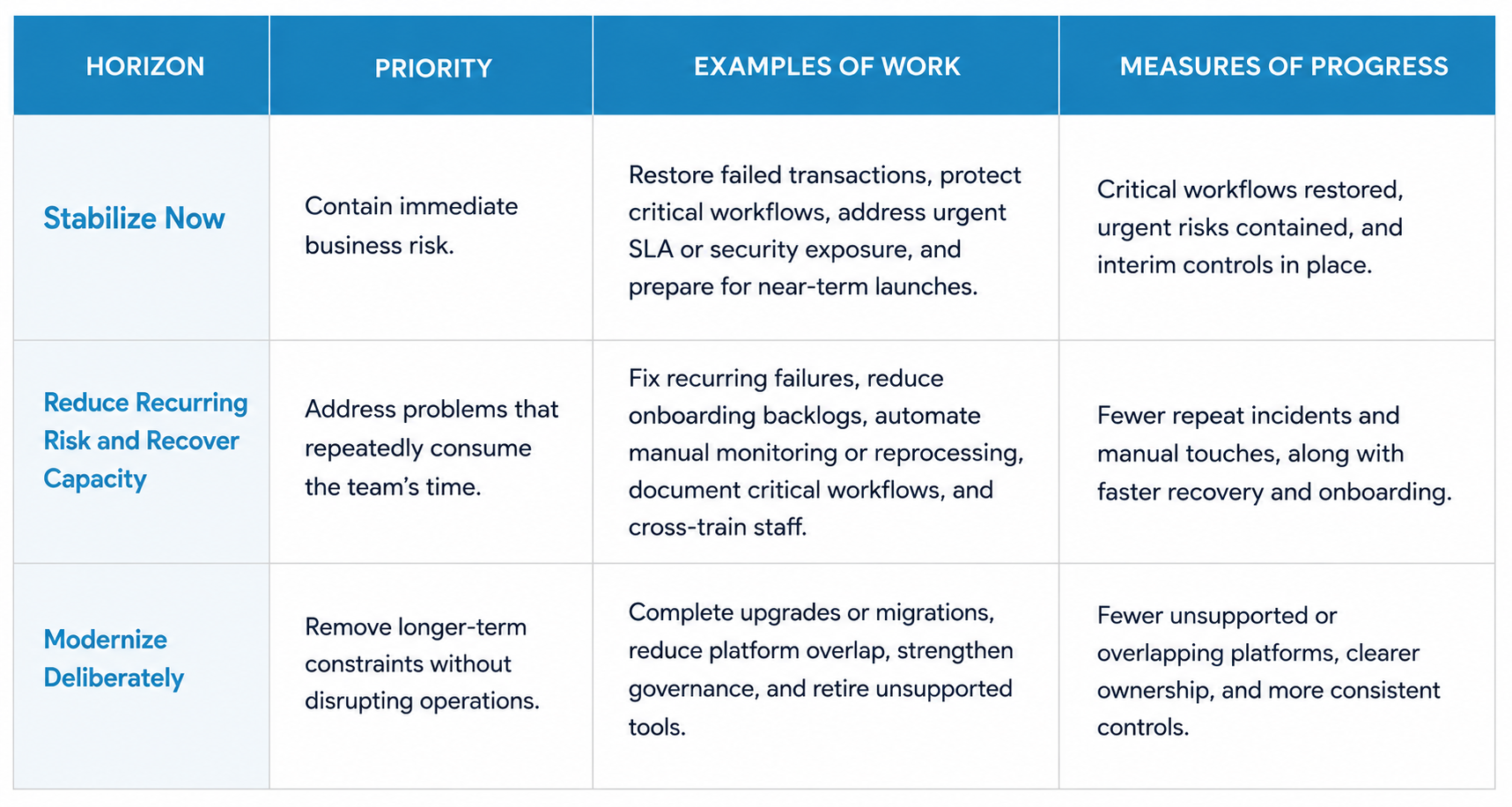
Once you have ranked the gaps, organize the work into three time horizons. For each priority, define the owner, desired outcome, dependencies, capacity required, timing, interim controls, and measures of progress.

Where Remedi Can Help
If your integration environment assessment reveals EDI/B2B production, platform, or capacity gaps your team may not be able to address alone, reach out here to discuss how Remedi can help you evaluate the environment and provide support if needed.
About Us
Remedi helps customers succeed with the platforms they prefer, from IBM, Cleo, Microsoft, 1 EDI Source, SEEBURGER, Boomi, OpenText, and beyond.
FAQs
1. What should a new integration leader assess first?
Start with active risks to business operations, customers, security, compliance, and near-term commitments. Then build a working inventory of critical workflows, platforms, owners, dependencies, and support arrangements.
2. How should integration environment gaps be prioritized?
Apply consistent criteria across people, production, and technology issues, including business impact, urgency, recurrence, exposure, dependencies, effort, and capacity returned. Separate immediate containment from remediation and longer-term transformation.
3. How can integration leaders reduce dependence on one or two specialists?
Prioritize documentation, cross-training, and recovery procedures for the most business-critical workflows. Protect the specialists’ time and avoid asking them to document the entire environment while maintaining a heavy production workload.
4. When should an integration leader consider outside support?
Consider outside consulting or staff augmentation when urgent stabilization, specialized platform work, backlog reduction, or a migration exceeds the internal team’s available capacity. Use permanent hiring for enduring roles the organization needs to own.
5. What should an actionable integration improvement plan include?
Define the business problem, owner, desired outcome, dependencies, capacity, timing, interim controls, and measures for each priority. Sequence the work across stabilization, recurring-risk reduction, and longer-term modernization.