

For decades, various industry voices have predicted the demise of electronic data interchange (EDI). Yet, it continues to evolve. With roots in standardized electronic cargo messages, it’s only natural that EDI would become the backbone of today’s supply chains.
This article is the first in our new four-part series, The Modern Integration Mix. We’ll be exploring how EDI, MFT, EAI, and APIs serve distinct but complementary roles in today’s integration environments.
Before we dive into why EDI is key to global supply chains, let’s look at how the original data integration tech came to drive them. Some claim EDI may be past its prime. Those people are likely not CEOs of multibillion-dollar automotive or healthcare organizations whose organizations have come to rely on it.
Is EDI Outdated Technology?
EDI has lasted because it solved a universal business problem: Glacially slow and expensive document exchange executed by error-prone humans. While all industries would eventually benefit from the technology, the first industry EDI transformed was transportation. Which was not an accident.
The man most closely associated with EDI’s development, Edward A. Guilbert, took the concepts he proved during the Berlin Airlift to DuPont in the 1960s. There, he helped solve a persistent profit killer for the tank trucking industry.
The problem was a familiar one to managers in other businesses as well: inconsistent, non-compatible, and incomplete paper records. Today, EDI enables organizations in all industries to automatically exchange standardized business documents.
EDI makes such exchanges possible at scale across different operating systems, platforms, ERPs, trading partners, and last but not least, borders.
Like electricity, EDI is long-established but invisible commercial infrastructure. And like that vital utility, EDI is indispensable to supply chain operations.
Yet for all the crucial activities it drives, the only time most people think about what EDI makes happen is if it stops working.
Fortunately, one of the reasons EDI enjoys such wide acceptance across industries is because of how stable it is. Its resilience also stems from its ability to evolve how it automates business-to-business transactions.
EDI’s adaptability stems in large part from the work of X12. X12, chartered by the American National Standards Institute (ANSI), is a non-profit. It creates and maintains EDI standards and XML schemas. These standards support business processes globally.

Why Do Industries Continue to Rely on EDI to Drive Their Supply Chains?
EDI lets companies share business documents accurately and quickly, in nearly real-time if architected as such. It’s difficult to overstate the impact of this capability on streamlining and automating operations.
EDI helps organizations large and small plan their physical and financial activities with confidence. EDI allows retailers, manufacturers, carriers, and other trading partners to automate dependent activities.
These activities can include:
- Scheduling warehouse labor and dock appointments around advance ship notices
- Reserving inventory and production capacity when purchase orders arrive
- Planning transportation and delivery routes using shipment information
- Issuing and validating invoices after shipment confirmation
- Scheduling supplier payments based on approved invoices and payment terms
In short, modern EDI platforms allow organizations to operate hyper-efficiently in today’s accelerated economy. They also give integration teams visibility into whether the business transaction completed successfully.
This helps them address exceptions before they can disrupt downstream operations.

What is EDI’s Role in the Modern Integration Environment?
EDI remains embedded in global supply chains for several reasons:
Universal Interoperability: Key industries like retail, healthcare, automotive, and logistics rely on structured EDI documents. Transaction types set by ANSI X12 in North America and EDIFACT globally make sure a purchase order always looks the same. This holds true no matter what internal systems a business uses, where they are based, or in which countries they operate.
Massive Transaction Volumes: EDI excels at automated, secure batch processing. It easily manages billions of important daily transactions. This includes shipping notices, inventory updates, and multi-line purchase orders.
Strict Legal and Regulatory Compliance: In fields like healthcare (HIPAA) and finance, EDI standards offer deep, auditable compliance protocols. It also offers legally mandated encrypted security protocols such as AS2 or AS4.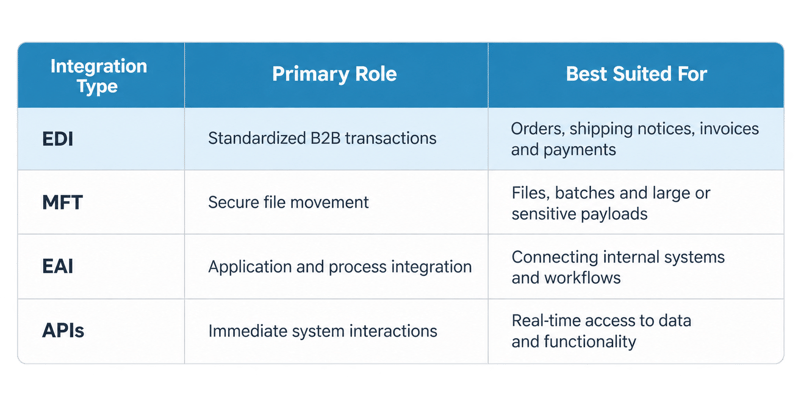
EDI remains the dependable transactional backbone for high-volume, repeatable business processes between trading partners.
Where Can I Get Support for My EDI Platform?
Contact Remedi for help modernizing, optimizing, staffing, or supporting the EDI environment your supply chain depends on.
About Us
Remedi helps customers succeed with the platforms they prefer, from IBM, Cleo, Microsoft, 1 EDI Source, SEEBURGER, Boomi, and OpenText, as well as emerging, legacy, and custom solutions.
FAQs
1. What is EDI?
Electronic data interchange (EDI) is a way to share business documents automatically. It uses standard formats. This exchange happens between organizations and their systems. Common EDI documents include purchase orders, acknowledgments, advance ship notices, invoices, and remittance advice.
2. Is EDI outdated?
No. EDI helps different organizations share structured business information easily. It is reliable and scalable. Modernization may change the platform, infrastructure, or operating model without eliminating EDI.
3. Why is EDI still important to supply chains?
EDI automates the documents that initiate and confirm orders, shipments, receipts, invoices, and payments. A failed transaction can disrupt operations and financial processes. This impact goes beyond the integration platform.
4. Are APIs replacing EDI?
APIs are changing how organizations share data. They are key when quick access or real-time interaction matters. However, APIs and EDI frequently serve different needs and can operate within the same end-to-end workflow.
5. How do EDI environments become complex?
EDI environments must consider many factors. They include different partners. There are also document standards and application systems. Business rules and security needs matter too. Lastly, teams must account for exceptions. Complexity can grow from custom maps. It can also come from poor documentation and old infrastructure. Inconsistent operational practices add to the problem.