

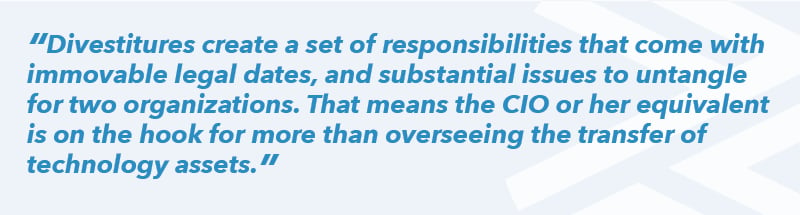
As we discussed in our acquisitions blog, the imperative for IT executives in these situations is to consolidate their EDI/B2B integration platforms and other business systems to one solution by day one or over time. Divestitures also create a set of responsibilities that come with immovable legal dates and substantial issues to untangle.
A divestiture creates two simultaneous executive responsibilities:
- The remaining business—often called RemainCo— which must continue operating securely and efficiently after the divested operation leaves.
- The divested business, NewCo, which must be capable of operating independently on Day One or under a clearly defined transition service agreement until the transition takes place post-transaction.
That means the CIO or equivalent executive is on the hook for more than overseeing the transfer of technology and assets. IT leaders could be expected to:
- Help establish what is included/excluded in the transaction
- Determine which applications, workflows, data, contracts, employees, and infrastructure are dedicated, shared, or excluded
- Participate in making NewCo operationally viable
- Protect RemainCo from disruption, unauthorized access, and unsupported dependencies
- Define and deliver transition services
- Support due diligence and buyer questions without exposing unrelated company information
- Meet Legal Day One requirements while building toward full separation
- Maintain service levels for customers, suppliers, carriers, financial institutions, and other external parties
- Control costs, deadlines, and service levels that may already be embedded in the transaction agreement
- Retain the people and knowledge needed to complete the separation
EDI/B2B/system integration environments enable transactions and data exchange that cross organizational boundaries and internal application systems. They connect internal systems along with processes to customers, suppliers, logistics providers, financial institutions, and other trading partners.
Those environments reveal the dependencies that IT executives must separate. It’s true that a divestiture and the new responsibilities they bring may be a relatively rare event for most organizations.
But relative rarity doesn’t automatically equate to a remote possibility. In their 2026 Global M&A Outlook, KPMG calls 2026 the year of the carve-out. A carve-out is one type of divestiture among several.
Before we go any further, let’s take a look at what a divestiture is.
What is a Divestiture?
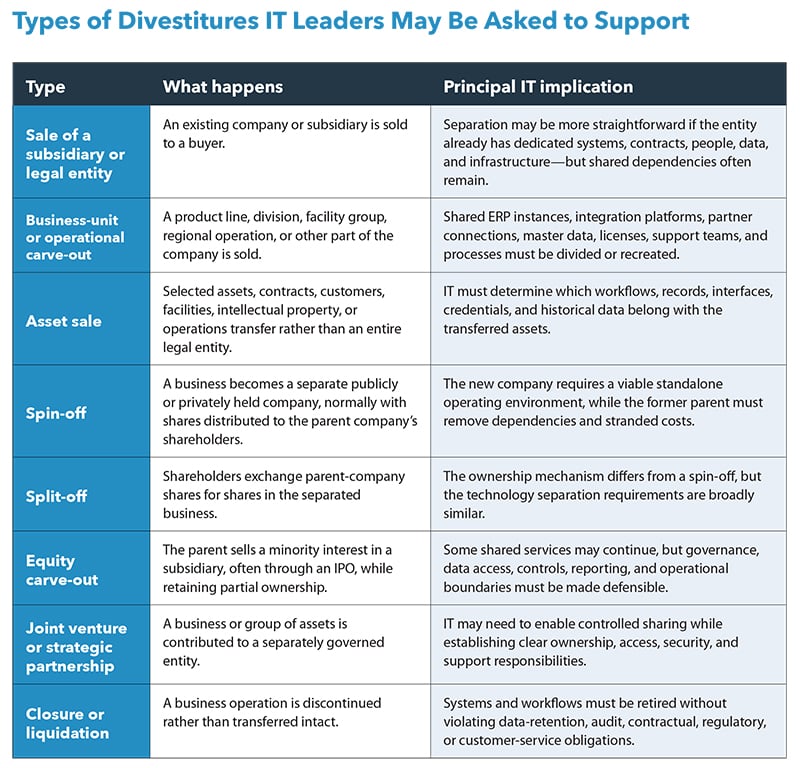
Broadly speaking, a divestiture is the separation or disposal of a company, subsidiary, business unit, product line, operation, or group of assets from its current parent. The business may be sold, spun off, split off, contributed to another entity, or closed. Divestiture is the business transaction, while separation is the operational work IT organizations must contend with.
Capabilities once supported inside one enterprise must be assigned, copied, replaced, or temporarily shared across two organizations—NewCo and RemainCo.Divestitures can take several forms, and each creates a different separation perimeter for IT. For example, even a dedicated environment may depend on shared ERP data, identities, contracts, infrastructure, people, partner identifiers, or monitoring processes.
What Are Some Common Types of Divestitures?
Whatever form it takes, the IT executive’s responsibility begins by translating the deal perimeter into an executable operating and technology separation. Those responsibilities will differ depending on the mechanics of the deal.
What is the IT Leader’s Role in a Divestiture?
In a divestiture, the CIO or IT Director’s long-term responsibility is clear: To ensure RemainCo continues operating securely and reliably after the separation. IT leadership must also help prepare NewCo to perform required business operations on Legal Day One—or through a controlled temporary arrangement.
Depending on the transaction, NewCo or its buyer may have its own CIO and IT staff, requiring both organizations to coordinate their responsibilities throughout the separation.
This means IT must inventory:
- What transfers
- What remains
- What is shared/split
- What must be duplicated or replaced
- What cannot continue to be shared for legal, contractual, security, or operational reasons
- Transaction-agreement commitments
- Data-transfer limits/guidelines
- Privacy and retention obligations
- Legal holds
- IT contracts assignability
- Audit evidence
- Security controls
- Testing and cutover dates
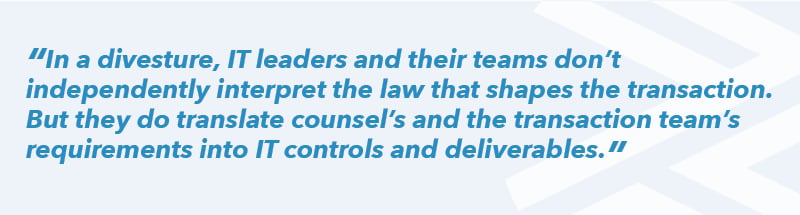
IT leaders and their teams don’t independently interpret the law and agreement that shapes the transaction. But they do translate counsel’s and the transaction team’s requirements into IT controls and deliverables.
Examples include:
Delivering these elements means creating governance that makes ownership and decisions explicit across the deal team, applications, infrastructure, cybersecurity, data, operations, vendors, and trading partners.
According to Deloitte’s 2026 Global Divestitures Survey, organizations that prioritize early separation design and readiness are more likely to meet expectations for timing and ROI, either through proceeds, smooth transition, or reduced operational costs of the separated business unit.
What is the Role of a Transition Services Agreement?
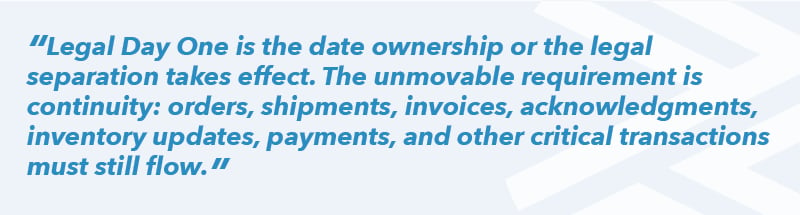
We’ve said Legal Day One is the date ownership or the legal separation takes effect. The unmovable requirement is continuity: orders, shipments, invoices, acknowledgments, inventory updates, payments, and other critical transactions must still flow.
Just as important, cross-company access must stop at some defined point. A Transition Services Agreement (TSA) can help govern the process that defines how long to grant access to IT services, and when to revoke it.
IT leaders facilitate early separation design by surfacing resource and knowledge capacity and capability gaps well upstream, recognizing the same people may be expected to run production and execute the separation.
From there, they use the perimeter and dependency assessment to set realistic TSA scope, cost, staffing, sequencing, and buyer expectations before dates become fixed and timelines too expensive to change.
A TSA may allow the seller to provide ERP/business system processing, EDI/integration services, infrastructure, connectivity, monitoring, service desk, security administration, or other capabilities while NewCo builds or receives its environment.
At the same time, while a broader TSA can reduce Day One disruption, it’s not a magic bullet.
Each provided service creates cost, governance, access, performance, and exit obligations. It’s critical that IT leaders define services, service levels, owners, pricing, change control, incident escalation, security responsibilities, and termination dates with business and legal teams.
A successful divestiture happens when the following occurs with little to no disruption to RemainCo’s daily operations:
- NewCo assumes full responsibility for its integration and larger IT environment
- Required partners and workflows are operating under NewCo control
- Temporary dependencies are retired
- RemainCo’s access or support obligations are removed or formally retained where required
The TSA defines when separation must be achieved, making exit planning an essential element of its design. Missing the exit date can extend cost and risk for both organizations.
How Do You Separate the Integration Environment Without Disrupting the Businesses?
Some partners may continue trading with both businesses; one relationship may need to become two without duplicate/misrouted/missing orders, invoices, and acknowledgments, or transactions assigned to the wrong legal entity.
Sorting the dependencies can be messy, but it’s critical to a stable transition. Keeping things clean means IT teams need to inventory:
- Changes to legal names
- Customer/vendor numbers
- ISA/GS identifiers
- AS2 endpoints and certificates
- VAN mailboxes
- API credentials
- Remit-to and banking information
- Ship-from/ship-to locations
- Document routing
- Testing requirements
- Support contacts
- Contract ownership
The punch list for IT leaders doesn’t stop at identifying entanglement inside the EDI/B2B integration environment. They also must capture the operating knowledge around the technology to determine who:
- Monitors failures
- Performs retries
- Handles partner exceptions
- Approves changes
- Supports seasonal peaks
- Understands undocumented partner-specific logic
How Do You Protect Both NewCo and RemainCo?
Divestitures create potentially difficult ownership and security questions. This requires IT leadership to determine:
- Which records RemainCo must retain
- Which current and historical records belong to NewCo
- Whether some data must be copied, filtered, masked, archived, or excluded
- How shared master data and reference tables will be divided
- Who can access what during the TSA period
- When former employees, buyer personnel, vendors, and service accounts should gain or lose access
- How audit trails, retention obligations, privacy requirements, and legal holds will be preserved
- How credentials, certificates, encryption keys, and privileged accounts will be transferred or replaced
Resolving these issues successfully means balancing competing realities. NewCo needs sufficient data and access to operate on Day One or at transition. RemainCo must prevent the divested business from accessing information that was not part of the transaction.
While IT executives have shared responsibility in making NewCo a viable business at transition, it’s important they recognize the potential impacts to the organization afterwards.
Once formally separated, RemainCo can discover:
- Software and infrastructure sized for the former combined company
- Contracts and licenses that cannot be reduced immediately
- Shared integrations that must be redesigned
- Support processes that no longer fit
- Stranded costs (software, infrastructure, contracts, and support functions) that were previously allocated across both businesses
- Staff reductions or knowledge gaps
- Temporary obligations to support NewCo
- Security exposure created by lingering connectivity or access
- Technical debt introduced to meet the transaction date
Therefore, CIOs need two coordinated plans: a standalone-readiness plan for NewCo (collaborating with and supporting NewCo and their IT personnel) and a stabilization/rationalization plan for RemainCo.

How Can Remedi Support Your Team in a Divestiture Scenario?
We said at the outset that EDI/B2B/system integration is a revealing place to assess separation readiness. That’s because it connects internal applications, systems, and business processes to external partner commitments.
This means that your divestiture plan will likely require any or all of the following: EDI/B2B/integration environment assessment, dependency mapping, environment replication, partner transition, testing support, or temporary operating capacity.
Reach out here if you think you may need outside expertise to define and execute the integration work while maintaining business continuity.
About Us
Remedi helps customers succeed with the platforms they prefer, from IBM, Cleo, Microsoft, 1 EDI Source, SEEBURGER, Boomi, OpenText, and beyond.
FAQs
1. What is the difference between a divestiture and a carve-out?
A divestiture is the disposal or separation of a business, subsidiary, operation, or assets. A carve-out is a form of divestiture in which part of a larger enterprise must be separated from shared systems, services, data, people, contracts, or processes so it can be sold or operate independently.
2. What is Legal Day One in a divestiture?
Legal Day One is the date ownership transfers or the separation legally takes effect. Both NewCo and RemainCo must be able to conduct required business on that date, even if temporary services or shared systems remain in place under controlled arrangements.
3. What does a Transition Services Agreement cover?
A TSA defines services the seller will provide temporarily after close—potentially including ERP processing, EDI/B2B integration, infrastructure, connectivity, monitoring, support, and security administration—along with service levels, pricing, responsibilities, and exit dates.
4. Why can’t an EDI/B2B environment simply be copied for NewCo?
A platform or map may depend on shared applications, partner profiles, identifiers, certificates, endpoints, lookup tables, custom code, monitoring processes, and employee knowledge. IT must identify which dependencies transfer, remain, or must be rebuilt before a copied environment can operate independently.
5. What are stranded IT costs after a divestiture?
Stranded costs are expenses that remain with RemainCo after the associated business, workload, or revenue has left. Examples include enterprise licenses, infrastructure, vendor contracts, and support functions that previously served both RemainCo and the business that became NewCo.