

You have an EDI environment that mostly works. Choosing the right kind of support for it matters more than most teams realize until something breaks.
The wrong choice costs more than money. It costs time, people, and the goodwill of every trading partner waiting on an 856 that never showed up.

Why Your Current Setup Might Be Costing You More Than You Think
Most EDI environments weren’t designed with a support model in mind. They grew. And somewhere along the way, one or two people became the single point of failure for the entire trading partner network.
If your EDI environment depends on someone who ‘just knows how it works,’ you’re carrying a risk that won’t show up in your budget until it’s too late to manage.
The Real Cost of ‘We Handle It Internally’
Most IT leaders underestimate what in-house EDI support actually costs when you count everything.
- Bus factor. When one person holds all the institutional knowledge about your maps, trading partner configs, and monitoring routines, you’re one resignation away from a crisis. A vacation can be enough to find out what you’ve been missing.
- Hidden hours. Internal teams typically spend time on EDI maintenance that they don’t officially track. That time shows up as delayed projects and burned-out staff, not as a line item.
- Chargeback exposure. If an 850 doesn't reach a supplier's system, they don't know an order exists. Nothing moves. By the time someone figures out the PO never landed, lead times are blown and the downstream schedule is already compromised.

What are the Real Options? A Plain-English Breakdown
The vendor landscape makes this more complicated than it needs to be. Let’s cut through the packaging and look at what each model actually involves.
Option 1: Keep It In-House with Dedicated Staff
You hire one or more EDI specialists, permanent or contract, who own the environment day-to-day. This works in high-volume environments where deep institutional knowledge pays off, or where strict data residency requirements complicate external options.
The problem is recruiting. Specialized EDI talent is hard to find, and the EDI workforce is aging. A replacement hire can take 60 to 120 days. In the meantime, you’re paying full salary and benefits for a skill set you may only need at 60 percent capacity on a normal week.
Option 2: Project-Based EDI Consulting
You bring in consultants for a specific migration, audit, or onboarding surge, then release them when the project closes. This is the right call for ERP transitions, post-acquisition partner consolidations, or one-time modernization work. The catch is that once the engagement ends, the expertise goes with it, so if the same problem surfaces six months later, you’re starting over.
Option 3: Managed EDI Services
A partner takes ongoing operational responsibility: monitoring, error resolution, trading partner communication, certificate management. You get predictable costs, 24/7 coverage, and documented SLAs without building that capability yourself.
Watch the contract terms carefully. Some traditional managed services providers lock clients into proprietary platforms. When you decide to leave, your configurations and data may not be as portable as you assumed.
Option 4: Co-Sourcing
This is Remedi’s approach. You retain ownership of the software and your integration IP. Remedi acts as an extension of your team. We handle monitoring and error resolution while you keep strategic control of your supply chain data.
When your business changes, you can walk away from the arrangement on your terms. Your configurations and data stay with you, and the relationship scales up or down without holding your environment hostage.
Here’s how the four models compare across the criteria that actually drive the decision.
How Do You Know Which Model Fits Your Organization?
There’s no universal answer here. The right model depends on your transaction volume, your team’s current capacity, and how much operational risk you can absorb. Four questions will get you further than any vendor comparison.
The Four Questions That Drive This Decision
- What happens if your lead EDI person leaves tomorrow? If the honest answer is ‘we’d be in serious trouble,’ you have a bus factor problem that documentation alone won’t solve. That’s a strong argument for a managed or co-sourced model where coverage doesn’t depend on one person’s availability.
- How many trading partners are you onboarding per quarter? If the answer is more than two or three, a pure consulting model will leave you constantly re-engaging outside help. Ongoing managed support treats onboarding as a routine function rather than a recurring project.
- Do you need to own your integration software? If data residency requirements, audit obligations, or long-term flexibility matter to your organization, confirm you’re not signing up for a service that controls your configurations. The exit cost can be severe.
- What’s your actual EDI support budget, including staff time? Most organizations undercount internal EDI labor costs by 30 to 40 percent. Before you compare models, include monitoring hours, trading partner calls, and chargeback resolution time. The real number is almost always higher than the invoice.

How Remedi Approaches This Conversation
Before Remedi recommends anything, we do an audit. We take a thorough look at your environment: transaction volumes, error patterns, open port vulnerabilities, cipher configurations, and your team’s real capacity.
What comes back is an honest picture of where your environment is solid and where it’s quietly bleeding time or money.
What Remedi Brings to Each Engagement Model
Depending on where you are and what you need, Remedi can engage in four ways:
- Consulting and architecture. For organizations mid-migration, mid-M&A, or mid-ERP transition. Remedi architects the new environment and manages parallel testing so you don’t have a cutover that falls apart on a Friday night.
- Specialized staffing. Candidates vetted by Remedi’s own technical leadership, not keyword-matched by a recruiter who’s never opened a B2B Integrator environment. The difference shows up within the first week.
- Managed services. Full operational ownership of your EDI environment with proactive monitoring, error resolution, and certificate management. You keep the software license; Remedi keeps it running.
- Co-sourcing. Remedi embeds as part of your team. You keep the IP and strategic control. We keep the environment healthy.
What to Expect After You Make the Switch
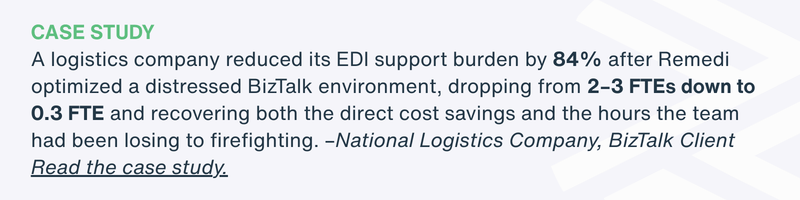
Trading partners stop calling about missed 997s, your team stops getting pulled off project work to chase map errors. In many environments, structured processes reduce onboarding timelines from weeks to days.
You also get something harder to put a number on: a documented environment with consistent practices, so the next person who joins your team isn’t starting from a blank page trying to reverse-engineer why something runs the way it does.
Want the full picture in one place?
The Remedi Guide to Modern B2B Integration Delivery Models walks through every support option available to mid-market and enterprise IT teams, with honest tradeoffs, decision criteria, and the questions worth asking before you commit. It's a useful reference whether you're building a business case or just trying to get the lay of the land.
Frequently Asked Questions
Can we switch engagement models if our needs change?
Yes. Remedi structures engagements to flex as your organization does. If you start with consulting support and later need full managed services, the transition doesn’t require rebuilding your environment from scratch. The goal is the right level of support for where you are now, with room to scale.
What’s the difference between co-sourcing and traditional outsourcing?
Traditional outsourcing often means handing over both operations and software ownership to the vendor. With co-sourcing, Remedi manages the environment but your configurations and data stay yours.
How long does it take to get a managed services engagement running?
For most environments, Remedi is fully operational within two to four weeks, depending on your current setup and the number of active trading partners. Clients running the Remedi Framework for IBM Sterling B2B Integrator typically onboard faster because the environment is already structured for visibility and monitoring.
We already have an internal EDI person. Do we still need outside support?
Possibly not full managed services, but even experienced internal teams benefit from a co-sourced backup model. Coverage is the gap, not competence. Nights, weekends, vacation, and sudden departures are where most EDI crises happen. A fractional support arrangement closes those gaps without replacing your team.
What does an EDI audit actually cover?
Remedi’s Integration Architecture Health Checks look at your current transaction flows, error rates, open port vulnerabilities, cipher configurations, and licensing efficiency. The output is a documented picture of where your environment is strong and where it’s quietly costing you.