

If you are still viewing Electronic Data Interchange (EDI) as a back-office utility that quietly hums in the background, it might be time to look again.
The “digital plumbing” that worked five years ago is struggling to meet today's demands for speed and compliance, let alone what will be required in 2026.
We are seeing a massive shift in how enterprise data exchange is handled. It is moving from a rigid protocol to a flexible, strategic integration layer. In 2026, B2B IT leaders are facing rising demands for real-time data, stricter security, and deeper integration with modern cloud platforms.
The future of EDI isn’t optional. It’s composable, intelligent, and mission-critical. Here is what is driving the change and the four trends you need to watch for 2026.
What’s Driving Innovation?
Why the sudden urgency to modernize? It usually boils down to pressure points that IT Directors and Managers face daily, such as security risks and the need for supply chain visibility.

Driving Factors for 2026
- Real-Time Expectations: Partners demand immediate visibility into order status and inventory.
- Cloud Mandates: The need to integrate EDI with cloud applications and APIs is making legacy on-premise tools obsolete.
- Security verification: IT managers need to make sure their organization is protected from evolving cyber threats.
4 Must-Watch EDI Trends for 2026
These four trends, spanning architecture, security, and connectivity, are fundamentally changing how IT leaders manage their B2B data exchange strategy.
1. The iPaaS Migration: Unifying EDI, API, and ERP
The separation between EDI translators and API management is ending. The trend for 2026 is the migration toward platforms that handle everything in one place. When you unify these systems, you reduce vendor sprawl and future-proof your tech stack.
2. Composable EDI: Breaking Down the Monolith
Traditional EDI systems were often built as monolithic platforms—rigid, tightly coupled, and difficult to modify. The future lies in Composable EDI: a modular approach where components can be independently deployed, replaced, or upgraded without impacting the entire system. By adopting clean architectural principles, organizations gain the flexibility to evolve their integrations, introduce new capabilities, and adapt to changing business requirements without disrupting core operations.
3. API-First Integration for Faster Onboarding
Onboarding new trading partners is one of the biggest challenges in B2B integration. The 2026 trend is an "API-First" approach, serving as a low-friction gateway for partners while EDI handles the heavy lifting behind the scenes.
4. Zero-Trust Security Models
Security is a common challenge with EDI. In a Zero-Trust model, every transaction is verified at every connection point so data is managed in compliance with relevant frameworks and regulations.
The Cost of Ignoring These Trends
Sticking with a legacy "set it and forget it" mindset carries real risks. We often see organizations struggling with technical debt, where they have a small IT staff trying to maintain complex systems.
Ignoring modernization leads to scalability issues and difficulty managing integrations as volume increases.
"With [Remedi] Integrator and Framework, we look like a Porsche when we really have a Volkswagen IT staff. It allows us to present a much larger technical presence than we actually have." - Remedi Customer
How Remedi Helps You Prepare
At Remedi, we help IT leaders prepare for these shifts through a combination of strategic consulting, proprietary tools, and expert staffing.
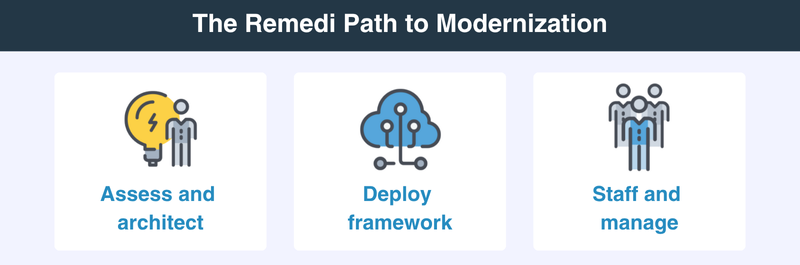
The Remedi Path to Modernization
- Assess and architect. Consultants evaluate your current environment and design a scalable architecture.
- Implement a clean, flexible architecture. Modernize your platform with modular design principles that enable scalability, easier enhancements, and reduced disruption—across systems such as IBM Sterling B2B Integrator.
- Staff and manage. Deploy expert consultants or managed services teams to handle mapping, testing, and ongoing maintenance.
What You Gain by Preparing Now
Modernizing isn't just about avoiding problems; it's about gaining a competitive edge. By embracing these trends, organizations can acquire the means to pivot more quickly to new market opportunities and significantly reduce the time it takes to get up and running with new partners.
Real-World Impact
Organizations that modernize their EDI environments consistently report one major advantage: speed. The ability to move from planning to production quickly changes how IT teams support the business.
This acceleration drives measurable outcomes, including:
- Faster trading partner onboarding
- Real-time visibility into orders and inventory
- Reduced maintenance through modular, clean architecture
- Greater scalability as transaction volumes grow
When EDI evolves from a rigid back-office utility into a flexible integration layer, IT teams can operate with greater agility—supporting new initiatives, meeting compliance requirements, and responding to market changes without being slowed by legacy constraints.
Want to learn more about EDI trends? Check out our frequently asked questions below.
Ready for 2026?
You don't have to navigate modernization alone. Remedi helps you assess your current architecture and build a modern, strategic integration platform tailored to what’s next.
Frequently Asked Questions About EDI Trends
What are the top EDI trends to watch in 2026? The most critical trends include the shift toward Composable EDI architectures and the adoption of iPaaS for unified integration. Other major trends are the rise of Agentic AI to automate error resolution and the move to hybrid EDI-API environments with Zero-Trust security.
Will APIs eventually replace EDI completely? No, APIs are unlikely to fully replace EDI in the near future because of EDI's entrenched role and robust standardization for batch processing. A hybrid approach is emerging where APIs handle real-time status updates while EDI manages complex, high-volume document exchanges.
How is AI used in EDI integration? AI is transforming EDI by automating complex data mapping and predicting supply chain disruptions. Tools like Agentic AI can autonomously resolve transaction errors, optimizing workflows and reducing manual intervention in real-time.
What is "Composable EDI" and why does it matter? Composable EDI refers to a modular architecture where integration capabilities are interchangeable blocks rather than a monolithic system. This matters because it allows IT leaders to upgrade specific components without risking the stability of the entire EDI environment.
What is a Zero-Trust security model in B2B integration? Zero-Trust security assumes no transaction is safe by default, requiring continuous verification from every established trading partner. This approach mitigates supply chain risks by enforcing strict identity validation and encryption at every connection point in the network.
How does EDI support ESG reporting and compliance? Modern EDI systems can track and validate granular supply chain data, such as carbon footprints or ethical sourcing certifications, within transaction metadata. This capability provides the auditable "paper trail" necessary for accurate Scope 3 emissions reporting and meeting new regulatory standards.
What is the difference between iPaaS and traditional EDI? Traditional EDI relies on siloed, on-premise software focused solely on B2B exchange. iPaaS (Integration Platform as a Service) unifies EDI, APIs, and internal applications in the cloud. This provides a single view of all data flows, offering better scalability and reducing the need for multiple vendors.
What is "API-First" partner onboarding? An API-First strategy uses APIs as the primary, simple entry point for trading partners, eliminating the need for them to have deep EDI expertise. The system then translates these API inputs into standard EDI formats in the backend, accelerating onboarding times while maintaining internal data standardization.
How does hybrid integration reduce supply chain costs? Hybrid integration lowers costs by routing data through the most efficient channel, using low-cost APIs for frequent status checks and reserving EDI bandwidth for massive batch files. This strategy prevents "over-processing" fees and reduces the manual labor required to manage disparate systems.