

Key Highlights
- Baseline Mapping: Start by mapping your current costs so you can see where your budget's actually bleeding.
- Intangible Wins: Focus on things like scalability. They give your team the edge they need for the long haul.
- Accurate Modeling: Watch out for service costs or manual fixes; if you leave them out, your financial model won't hold up.
- Real Data: Use clear models and real numbers to make your ROI case strong and sustainable.
You’re likely spending a lot on EDI, but it’s often tough to show exactly what you’re getting back. In a world of tight budgets, you need to show the real-world value of EDI if you want to win over leadership and keep your digital goals moving forward.
EDI ROI is just the money you get back from working faster, being more accurate, and growing your business after you set things up. You'll see these wins in lower bills, faster document processing, happier partners, and a team that can handle more work without breaking a sweat.
Our team at Remedi is here to help. We’ll help you build ROI models that actually make sense with tools like our EDI Cost Savings Calculator and regular audits.
What Factors Go Into EDI ROI?
To build a solid business case, you have to look at what you’re spending next to what you’re saving. Think of it as a full picture of your investment.
Direct Cost Reductions
Direct savings are the easiest way to prove your point. These numbers link right to cash expenses like labor and materials, so CFOs usually want to see them first:
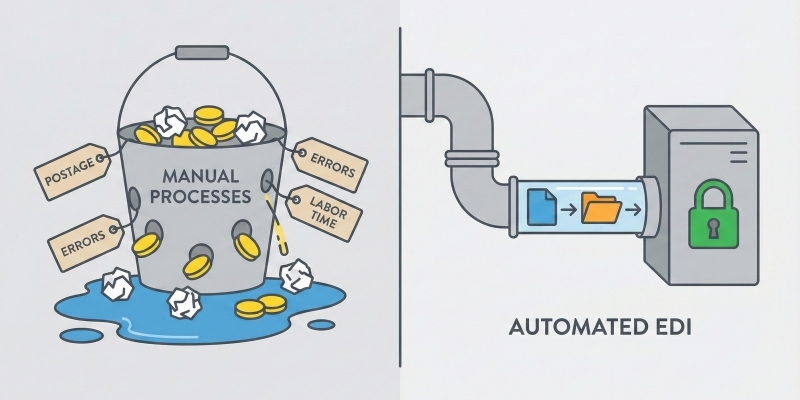
- Paper and Postage: You’ll cut material and delivery costs the moment you swap physical mail for digital files.
- Labor Efficiency: Automation cuts the hours your team spends on manual typing and double-checking data.
- Error Reduction: When you have fewer mistakes to fix, you save both time and money.
Indirect Benefits
Indirect perks drive huge value over time by making your business more agile and your partners happier. These matter just as much, even if they don't always show up on a balance sheet right away:
- Partner Satisfaction: You'll build trust and loyalty when your transactions are fast and accurate.
- Compliance Support: Automated systems help you stay on the right side of industry rules and partner standards.
- Cycle Times: You’ll move documents through the supply chain faster, which helps your cash flow and service.
Risk Mitigation and Opportunity Enablement
Smart moves protect your company from big headaches. These benefits help you build a business that can handle whatever comes next:
- Business Continuity: You’ll rely less on manual work that’s prone to human error.
- Scalability: A strong foundation lets you add more partners or enter new markets without overwhelming your systems.
- Real-Time Decisions: Visibility tools help you see what’s happening right now so you can make fast pivots.
How Do You Calculate EDI ROI?
A solid plan makes sure you count both the obvious savings and the hidden perks. It helps you build a model that your friends in finance and operations can actually get behind.
To get there, you'll need to look at the hard numbers. We use a straightforward formula to see exactly how much your investment is working for you.

Once you’ve got the formula down, the next step is plugging in your actual transaction data. The template below shows an example of how the savings add up when you compare what you’re spending now to what you’ll save by automating your most common documents.
Sample template
How to use this template:
- Find your baseline: Look at what you're spending now. Count the hours spent on paperwork, the cost of stamps, and the time it takes to fix errors.
- Look at your documents: Break down savings by document type so your numbers stay sharp. Figure out what an invoice or purchase order costs you now versus what it'll cost after the upgrade.
- Count the time saved: Measure the hours your team gains back through automation. You can use that extra time for more important, strategic projects.
- Plan for growth: Make sure your model accounts for the future. You want a system that handles more work without needing to hire a huge team.
- Do the math: Add up all the costs—software, setup, and training. Then compare that total to what you're going to save over the year.
You can make the process easier still when you download our EDI Cost Savings Calculator. Answer a few questions, calculate your total cost savings, and easily tailor the results to fit your business.
What Are Common Mistakes in Calculating EDI ROI?
Even the pros can trip up if they miss a few key details:
- Onboarding Costs: You have to plan for testing and support when you bring on new partners. If you skip this, your ROI looks better than it actually is.
- Intangible Factors: Time savings and lower risks still matter, even when they're a little harder to put a price tag on.
- Total Expenses: Don’t just look at the software. You’ve got to include consulting fees, setup, and training.
- Ongoing Metrics: Keep track of your ROI after you launch to make sure you're still seeing improvements.
Verified ROI: What It Actually Looks Like in Practice
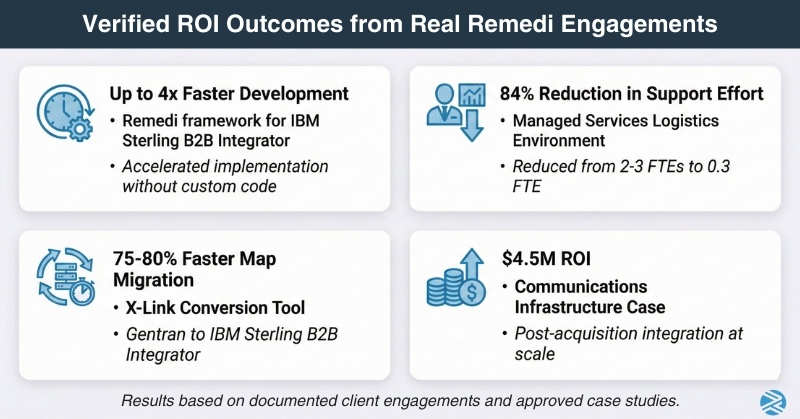
A high-confidence ROI model goes beyond spreadsheets to inform strategy. The graphic below illustrates the documented outcomes from real Remedi engagements, showing how different approaches yield significant returns.
Case Study 1: Get Value Faster After an Acquisition
Industry: Communications Infrastructure
Platform: IBM Sterling B2B Integrator
Approach: Remedi Framework deployment. After an acquisition grew its partner network, this provider had to combine several different systems without stopping work. Remedi used our framework to clean up the architecture and get rid of old legacy systems.
- Documented Results: They set things up 4x faster than before.
- ROI: $4.5 Million in ROI from cleaning up their infrastructure.
Case Study 2: Lighten the Support Load
Industry: Logistics & Supply Chain Services
Engagement: Optimization and managed services. This team was spending too much time manually fixing things in a messy environment. Remedi stabilized the system and set up proactive monitoring.
- Documented Results: They cut the support work from 3 full-time people down to about a third of one person's time.
- Efficiency: 84% reduction in the daily support burden.
Case Study 3: Speed Up a Legacy Migration
Industry: Wholesale / Manufacturing
Platform Transition: Gentran to IBM Sterling B2B Integrator
Tool: X-Link Map Conversion Utility. This client had to move a huge pile of old Gentran maps. Rewriting them by hand would have taken forever. Remedi used the X-Link tool to automate the move and check the work.
- Documented Results: 80% reduction in migration time.
- Timeline: The project dropped from 9 months down to less than 2 months.
Want to See More?
Visit our Resource Center. You’ll find a wide range of templates, tools, and downloads to help you determine the costs and value of implementing EDI in your organization.
Stop Guessing Your ROI: Prove It
EDI ROI is a business must-have, not just a line on a budget. Credible, supportable cost-reduction data can help make sure your projects get the green light.
Don’t rely on guesses. Use real numbers and clear benchmarks that’ll stand up to a review from the executive team. To learn more, get a free EDI assessment today.
Frequently Asked Questions
- What is EDI ROI? It’s the money and time you get back from your EDI setup through savings and better accuracy.
- How do you calculate it? Start with what you're spending now, estimate your savings per document, and add in the value of speed and fewer errors.
- Why is it hard to measure? Some wins, like lower risk or faster onboarding, are tough to quantify without the right tools and benchmarks.
- What metrics should I track? Keep an eye on your transaction volume, error rates, onboarding speed, and how well you're meeting your SLAs.