

It’s the oldest story in the world of EDI and B2B integration. Whether it’s migrating your on-premises EDI solution to the cloud, implementing a new ERP system (with impacts on existing integrations), or taking a new iPaaS or hybrid approach to your integrations, the risk is always there. Great expectations that become missed deadlines and lost stakeholder confidence.
It even happens to competent, high-performing teams. For example, by some estimates, up to 75% of ERP implementations fail. When we say “failure,” it means projects fail to meet deadlines, go over budget, or don’t deliver the expected performance improvements.
By association, these same statistics and reasons for failure can also be applied to business integration projects outside of ERP implementations and upgrades.
In this article, we’ll explore the factors behind why momentum disappears and share the tell-tale signs a project is flagging. From there, we’ll share a proven operational framework to get projects back on track with confidence and clarity.
What Causes Integration, EDI, and ERP Projects to Lose Momentum?
Migration and modernization projects rarely stall because teams stop caring. A study conducted by ERP advisors Panorama Consulting Group shows several factors are responsible.
Operational/environmental complexity, competing priorities, and capability/capacity gaps that compound faster than teams can respond are chief among them.
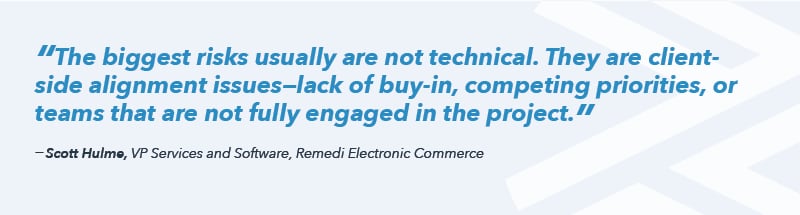
According to Scott Hulme, Remedi VP Services and Software, “The biggest risks usually are not technical. They are client-side alignment issues—lack of buy-in, competing priorities, or teams that are not fully engaged in the project.”
Today’s integration environments need to function as hybrid ecosystems. Legacy tech needs to increasingly sync with modern cloud infrastructure. People managing these environments often utilize EDI solutions deployed long before they started.
An ongoing challenge is getting integration systems developed in different eras by different vendors to play well together. In most environments, it comes down to integrating on-premise EDI/AS2 systems that primarily process in batches with real-time cloud systems, APIs and event-driven microservices.
Over time, supporting these separate integration solutions while trying to deploy something more strategic, modern, and comprehensive can lead to resource fatigue. It's caused by balancing important new project work with equally important day-to-day operations.
What happens when you add a lack of tool or platform-specific experience to the mix? Many modernization efforts can't help but stall.
Amid this project work, shifting business requirements can lead to scope creep and blown budgets. This can cause communication issues. In turn, technical, operational, and executive teams may struggle to connect.
Other factors slowing progress are unclear ownership, delays in decisions, and unrealistic timelines set before completing the discovery and design phases.
What Are the Signs a Project is Facing Headwinds?
After more than thirty years in the EDI/B2B integration space, we can say this about projects that stall. Most of them flash warning signs long before progress begins to collapse.
In the words of an operations director for a regional construction components and supply chain hub:
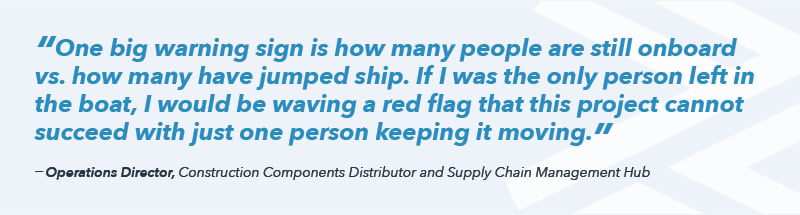
“One big warning sign is how many people are still on board vs. how many have jumped ship. If I were the only person left in the boat, I would be waving a red flag that this project cannot succeed with just one person keeping it moving.”
The challenge is recognizing the indicators in time to enable a successful intervention. The primary signs to watch for include:
-
Deadlines continue shifting without clear explanations
-
Teams spend more time in status meetings than executing work
-
Teams become more reactive and less strategic
-
Integration testing cycles often expose avoidable issues.
-
Escalations increase while measurable progress slows
-
Loose project and scope management
-
Issues with the vendor’s implementation team (turnover, under-resourced, missing milestones)
The foregoing is by no means a complete list, but you get the point. Projects never just grind to a halt one day after chugging along smoothly.
What Can Teams Do to Get Projects Back on Track?
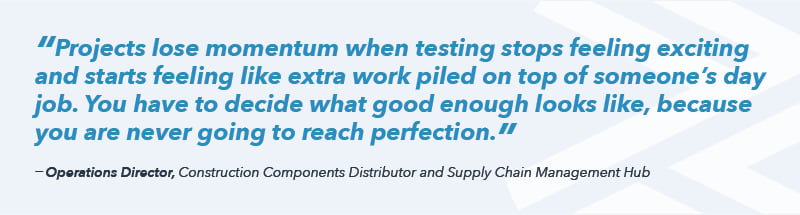
Teams that regain or maintain traction focus on stabilization before acceleration. To rebuild project momentum, start by restoring operational clarity. Clearing the fog around stalled projects involves a few simple steps.
Not every step may apply to every situation, but the following framework can help in most of them.
Step 1: Re-establish Project Visibility
-
Reassess current project status against original objectives
-
Identify hidden blockers and unresolved dependencies
-
Create transparent reporting around risks, priorities, and ownership
Step 2: Identify and Prioritize Execution Bottlenecks
-
Determine which issues are slowing progress most significantly
-
Separate critical-path work from lower-priority initiatives
-
Reduce unnecessary process complexity and approval delays
Step 3: Stabilize the Resource Model
-
Evaluate whether teams have the right technical and operational expertise
-
Address resource fatigue and overloaded contributors
-
Clarify ownership across internal teams, vendors, and partners
Step 4: Prioritize Achievable Wins
-
Focus on measurable milestones that restore confidence
-
Create momentum through phased execution goals
-
Rebuild stakeholder trust through consistent progress and communication
See this article for Army medevac-inspired insights on quickly restoring forward progress to projects that are going sideways.
What Role Can Outside Expertise Play in Regaining Traction on Integration Projects?
When integration initiatives lose momentum, outside expertise can’t resolve all of the issues we’ve identified. What the right resources engaged at the right moment can do is provide three critical ingredients.
One, they bring needed objectivity. They don’t have turf to protect or preconceived notions about the project or choice of platform.
Two, they can bring technical depth that can only come from previous navigation experience. Integration platform deployments, upgrades, and ERP migrations are major undertakings that most managers will tackle once or twice in a career.
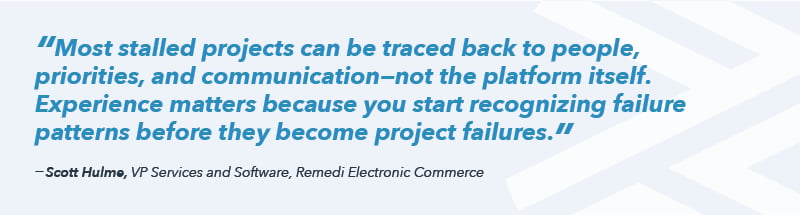
While they learn valuable lessons throughout the process, internal leaders can’t apply that wisdom in hindsight. Seasoned outside experts, on the other hand, can apply foresight to identify risks and failure patterns faster.
Lastly, effective recovery efforts depend on understanding how systems, integrations, and dependencies interact. Familiarity with integration platforms, ERP systems, and cloud environments reduces learning curves.
You already know that complex EDI/B2B environments require coordinated workflows across platforms and partners. And if you’re still reading this, you’re well aware that modernizing efforts carry risks to daily business, timelines, and team productivity, to name a few.
But the good news is, we’ve seen that it’s possible to move projects from failing to succeeding. If you’re struggling to get an EDI/B2B project back on track and you’d like to better understand if our experience might be helpful, reach out here.
About Us
Remedi helps customers succeed with the platforms they prefer, from IBM, Cleo, Microsoft, 1 EDI Source, SEEBURGER, Boomi, OpenText, and beyond.
FAQs
1. Why do ERP, integration, and cloud migration projects stall?
Most projects stall because complexity increases faster than teams can adapt. Common causes include resource fatigue, underestimated dependencies, shifting requirements, and lack of specialized expertise.
2. What are the earliest warning signs of a stalled project?
Frequent deadline changes, growing meeting volume, repeated testing failures, unclear ownership, and declining stakeholder confidence are all common early indicators.
3. Can stalled projects recover without starting over?
Yes. Many stalled projects recover successfully once teams regain visibility into blockers, stabilize resources, and refocus priorities around achievable milestones.
4. When should organizations consider bringing in outside expertise?
Organizations should consider outside support when internal teams become overloaded, execution slows significantly, or specialized migration knowledge is missing.
5. How can organizations reduce risk during ERP, integration, or cloud migrations?
Clear governance, realistic timelines, phased execution, proactive communication, and experienced technical leadership all help reduce risk and improve long-term outcomes.