

How to balance internal expertise with on-demand specialists—without stretching your team or your budget.
Electronic Data Interchange (EDI) still carries the weight of your supply chain. But finding and keeping the people who know how to run it is getting tougher every year. You already feel the pressure: more integrations, more partner demands, more tickets, and a shrinking pool of experienced EDI professionals.
A hybrid staffing model gives you a realistic way forward. It lets your internal team keep control of your systems while bringing in outside specialists when the workload spikes or a high-stakes project hits your desk.
Here’s how it works in the real world and how teams use this approach to keep data flowing without burning out their people.
What Is a Hybrid EDI Staffing Model, Really?
If you’ve tried to hire experienced EDI talent lately, you know the problem. The resume pile is thin, onboarding takes months, and losing one key analyst can put your operation at risk.
A hybrid model solves that by blending your in-house knowledge with external experts who can step in fast. Your team handles the day-to-day. Consultants take on the work that needs extra bandwidth, deep specialty skills, or the kind of experience you only get from seeing dozens of environments.
You get steady backup, so a departure or major initiative never puts you in a bottleneck.
How the Staffing Models Compare
Why Hybrid Models Work So Well
Integration work never fits neatly into a job description. One week, your team is onboarding a new partner; the next, you’re deep in an ERP migration. The load shifts constantly.
A hybrid approach adapts to those shifts:
- Scales when you need it. Large upgrades, seasonal volume spikes, or a sudden flood of partner requests no longer overwhelm your team.
- Protects continuity. When someone leaves—or goes on PTO—you aren’t scrambling to cover critical processes.
- Costs less than hiring your way out of the problem. You get access to top-tier talent without carrying the long-term expense of another FTE.
- Builds up your internal staff. Consultants don’t just do the work—they show your team new approaches and tools as they go.
This model works especially well in industries where supply chain timelines are tight and compliance penalties hurt.

What Happens When You Don’t Have a Hybrid Model?
Running everything internally sounds ideal until the workload spikes. Then the cracks show in the form of missed SLAs, overwhelmed analysts, and a backlog of mappings no one has time to finish.
Going external-only isn’t much better. Vendors can get the job done, but when they don’t understand your environment, troubleshooting takes longer and costs creep up.
Teams relying on either extreme often face:
- Burnout or turnover that puts operations at risk
- Escalating consulting spend without meaningful knowledge transfer
- Slow onboarding of trading partners
- More downtime and more firefighting
A hybrid model fills these gaps instead of forcing you to choose between them.
What a Successful Hybrid Model Actually Looks Like
A hybrid approach only works when the structure is clear. Strong models usually include:
- Defined roles. Your internal team owns the day-to-day. External consultants handle complex work, major initiatives, or temporary spikes in demand.
- Shared communication and documentation. Everyone works from the same playbook, which keeps the environment stable and reduces tribal knowledge.
- Flexible engagement. You dial resources up or down—without committing to long-term headcount.
- Ongoing improvement. Consultants mentor your team through real projects, not theoretical workshops. Skills rise across the board.
Picture one team with shared goals, not two disconnected groups.
How Remedi Builds Effective Hybrid Teams
Remedi has been doing this for more than 30 years, and our approach reflects that experience. We don’t replace your systems or take control away from your team. Our co-sourcing model supports your environment while you retain ownership and oversight.
Here’s what that looks like.
Specialized Staffing and Consulting
From analysts to architects, our people are vetted by technical leadership—not keyword-matching recruiters. They can jump into your ecosystem and contribute immediately.
Managed Services that Preserve Your Investment
We monitor your integration environment, resolve errors, and handle certificate renewals while your team keeps strategic control.
Training and audits
Health checks identify bottlenecks, security gaps, and opportunities to streamline. Side-by-side training lets your staff learn on your actual system, not in a generic demo environment.
Proprietary Tools that Cut Complexity
- The Remedi Framework speeds IBM Sterling deployments up to 4x while preventing spaghetti-code drift, a direct result of blending internal teams with Remedi specialists.

Results You Can Expect
When clients shift to a hybrid model, the improvements show up fast:
- Faster trading partner onboarding. No more waiting months for internal bandwidth to open up.
- Fewer outages and missed SLAs. You’re no longer dependent on one or two key people.
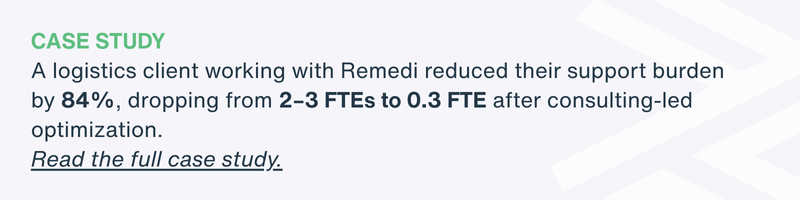
- Lower overall staffing cost. You avoid overspending on full-time hires while maintaining capability.
- Stronger internal teams. Your staff learns best practices by working alongside specialists.
- A more resilient integration environment. Teams stay steady even as business needs change.
Hybrid staffing allows modern integration teams to survive the talent cliff and still support the business.
Hybrid EDI Staffing Is the Smarter Path Forward
You don’t have to choose between overloading your internal team or handing the keys to an external vendor. Hybrid staffing gives you the flexibility, continuity, and stability your integration environment needs without sacrificing control.
If you're navigating complex systems or preparing for major change, Remedi can help you build the right mix of in-house talent and seasoned experts.
Let’s build a team structure that keeps your business moving.
Contact Remedi to learn how we can build the right hybrid model for your team.
FAQ
What is a hybrid EDI staffing model?
It’s a staffing strategy that combines internal IT and EDI employees with external consultants to balance knowledge, scalability, and cost.
Why are hybrid EDI staffing models effective?
They reduce risk, cut costs, and ensure agility by blending day-to-day internal operations with on-demand external expertise.
What challenges do hybrid staffing models solve?
They address turnover, talent shortages, high costs of full-time hires, and the limitations of external-only support.
What tools support hybrid EDI staffing?
Solutions like the Remedi Framework, IntelligentXchange (IX), and Business Transaction Intelligence (BTI) help internal and external teams collaborate effectively.
How do I know if my business needs hybrid staffing?
If you’re struggling with staff turnover, skill gaps, or scaling integration projects, hybrid staffing may be the right fit.