

In many legacy EDI environments, someone owns the environment the way a building superintendent owns an aging boiler — not by choice, but because nobody else knows how it works. At a logistics company, a senior analyst might spend half of every week on certificate renewals, failed transaction triage, and trading partner escalations, with no end in sight.
We see scenarios like this all the time, where a system runs but has never run well. Someone has to keep their hands on it constantly.
The cost of an arrangement like that spreads across manual support hours, recurring transaction failures, retailer penalties, and infrastructure that needs constant attention from people who have other work to do.
Leadership sees the cost of replacing the environment, but the cost of keeping it rarely gets totaled because it belongs to everyone. No one owns the number.
What Is Legacy EDI Actually Costing You?
Legacy EDI environments tend to degrade gradually rather than fail all at once. Transaction errors surface in whatever system happens to be downstream, so operations sees a fulfillment delay, finance sees a chargeback, and the integration layer that caused both problems often goes unexamined.
Teams normalize the dysfunction over time, so manual workarounds become standard procedure and support staff spend more time reacting than improving.
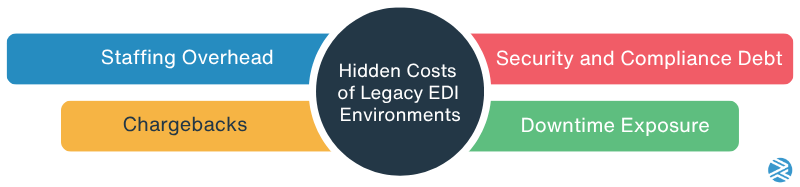
Most organizations see those costs in four areas:
- Staffing overhead tied to troubleshooting and support. The burden usually concentrates on one or two people and rarely surfaces clearly in staffing models.
- Downtime exposure from unstable integrations. The system stays online but transactions fail quietly, creating the same operational damage as a full outage without triggering the alerts that would get leadership's attention.
- Chargebacks linked to compliance failures and bad data. These bypass IT entirely and show up in accounts receivable, disconnected from their source.
- Security and compliance debt from unsupported infrastructure. The older the environment, the harder it becomes to patch safely, document accurately, or modernize without disruption.
A delayed EDI 856 transaction can trigger warehouse confusion, retailer penalties, and customer service escalations in the same afternoon. Most companies won't categorize any of it as an EDI cost, even though the integration layer caused all of it.
The operational damage is real; it just never gets totaled.
The Staffing Burden You're Probably Underestimating
When integration teams spend their days firefighting transaction failures, strategic work stalls, partner onboarding slows, and ERP initiatives sit in the queue because no one has bandwidth for proactive work.
There's also a longer-term talent risk hanging over many of these environments. Most still run on older translators and heavily customized mapping logic that only one person fully understands, often without a shred of documentation.
If that person leaves, the business faces expensive consulting costs and elevated operational risk almost immediately.
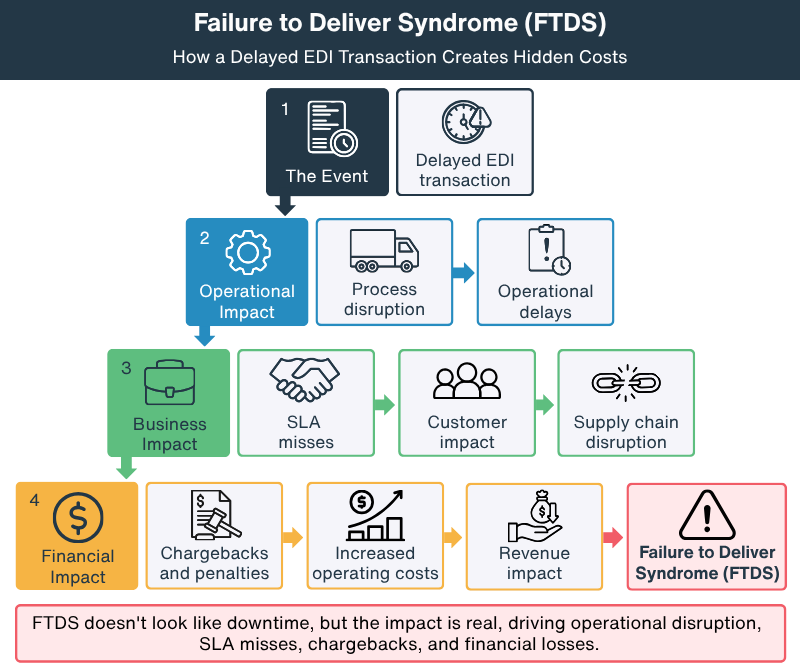
Failure to Deliver Syndrome: The Downtime Problem That Doesn't Look Like Downtime
In a degraded EDI environment, transactions keep moving, just incorrectly or too slowly. Functional acknowledgments can arrive late, inventory data might fall out of sync, and orders can queue overnight because a dependency failed quietly hours earlier.
By the time anyone notices, the losses have already spread across penalties, overtime, and missed shipments.
Integration problems can degrade transaction reliability enough to produce the same operational damage as downtime, including chargebacks, stalled production, and manual intervention at receiving docks, without triggering the alerts that would normally surface the problem.
The ITIC 2024 Global Server Hardware and Server OS Reliability Survey found that more than 90% of mid-size and large enterprises report downtime costs exceeding $300,000 per hour.
Unlike a system outage, however, FTDS rarely triggers the same urgency because the environment appears operational even as transaction failures create downstream operational and financial consequences.
Chargebacks: The Cost That Shows Up in Accounts Receivable
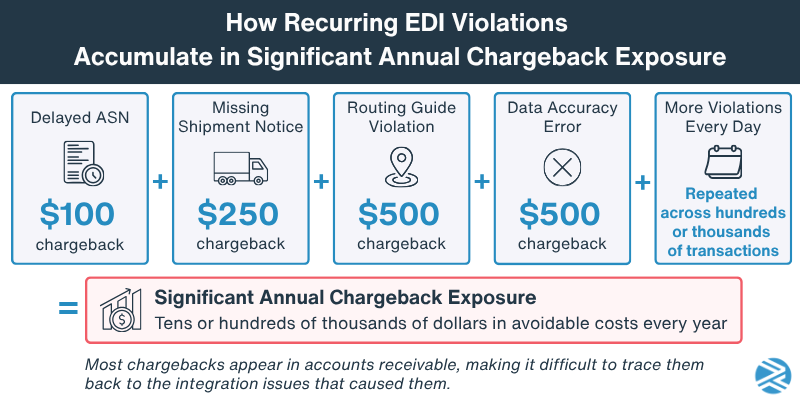
In high-volume retail environments, EDI chargebacks typically start at $100 per violation and can reach 5% of invoice value. A delayed or malformed 856 ASN is enough to trigger a penalty, and in environments with recurring transaction errors, those violations accumulate steadily.
The connection back to the integration layer rarely gets made because the penalties show up in accounts receivable, not in any system IT monitors.
For many organizations, chargebacks become a recurring cost of doing business rather than a signal that something deeper is wrong. A missed acknowledgment, inaccurate inventory update, or delayed shipment notification may appear isolated, but repeated transaction failures often point to larger issues within the integration environment.
The result is a cycle where penalties continue to accumulate while the underlying causes remain unresolved. The organization absorbs the financial impact without identifying the operational issues responsible for it.
Create a clean, simple infographic that illustrates how seemingly minor EDI violations accumulate into significant annual chargeback exposure. The visual should emphasize that individual penalties may appear insignificant on their own, but become a substantial financial burden when repeated across hundreds or thousands of transactions.
Security and Compliance Debt: The Cost That Compounds Quietly
Many legacy EDI environments still run on unsupported operating systems and heavily customized translators that survived years of ERP upgrades, acquisitions, and patchwork fixes. Teams keep those systems running through experience and caution more than stability.
The longer unsupported infrastructure stays in place, the harder it becomes to patch safely, document accurately, or modernize without disruption, and the security exposure compounds the whole time.
External pressure tends to arrive before internal teams are ready for it. Retailers tighten partner requirements, cyber insurance underwriters ask harder questions, and legacy EDI translators running on end-of-life operating systems represent documented ransomware vulnerabilities that most organizations are aware of but haven't yet addressed.
The challenge is that these risks rarely exist in isolation. Unsupported infrastructure, expired certificates, weak encryption standards, undocumented configurations, and underutilized software licenses often accumulate gradually across years and multiple departments.
Ownership becomes fragmented, making it difficult for any one team to understand the full scope of the exposure.
As a result, many organizations don't discover the extent of their security and compliance debt until an audit, a trading partner requirement, or a security incident forces the issue.
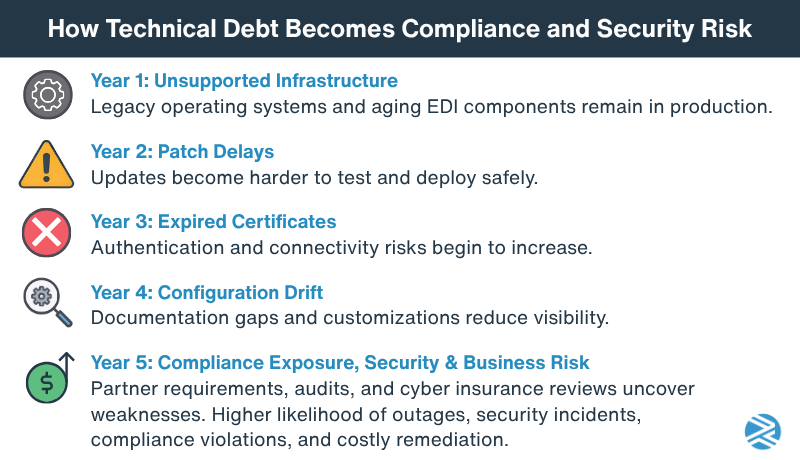
Security and compliance debt rarely appears all at once. It accumulates gradually until an audit, trading partner requirement, or security event forces action.
The Real Cost of Optimization: Why It's Less Than You Think
The assumption that often delays EDI modernization is that improvement requires a full platform replacement. Leadership sees the cost of a migration project immediately because it comes with a proposal, a timeline, and a budget. The cost of keeping the current environment rarely gets measured the same way.
For many organizations, the choice is not between doing nothing and replacing everything.
The reason optimization costs less than many leaders expect is that it builds on investments already in place. Existing integrations, trading partner connections, workflows, and software licenses remain in service while the parts creating the most support burden, operational risk, and maintenance cost get addressed first.
That changes the economics of the decision. Instead of committing to a large migration before seeing any return, organizations can improve reliability, increase visibility, and reduce operating costs within the environment they already own. Value starts accumulating before a replacement project ever enters the conversation.
Remedi's managed services model supports that approach. Consultants work alongside internal teams, helping manage infrastructure, monitor transactions, resolve issues, and transfer knowledge throughout the engagement. Clients retain ownership of their software, data, and processes while gaining access to specialized integration expertise when and where they need it.
Modernization is not always a replacement project. In many cases, it begins by finding the costs already running through the environment and removing them.
Learn the Cost of Doing Nothing
Before budgeting for a replacement project, understand what's really driving costs in your current environment. Learn how Remedi's Integration Architecture Health Check helps organizations uncover hidden inefficiencies, reduce operational risk, and identify opportunities to improve performance without a full platform replacement.
Schedule an Architecture Health Check
Frequently Asked Questions About the Cost of Legacy EDI
What are the hidden costs of a legacy EDI environment?
The costs of a legacy EDI environment often extend beyond software licensing and infrastructure. Organizations frequently absorb expenses related to manual troubleshooting, transaction failures, retailer chargebacks, delayed partner onboarding, compliance issues, and security risks. Because these costs appear across multiple departments, they are rarely measured as a single EDI expense.
How do EDI transaction failures affect business operations?
EDI transaction failures can disrupt order fulfillment, inventory visibility, shipping processes, and customer service operations. Even when systems remain online, delayed or inaccurate transactions can create the same operational consequences as downtime, including missed service-level agreements (SLAs), manual intervention, and shipment delays.
What is Failure to Deliver Syndrome (FTDS)?
Remedi defines Failure to Deliver Syndrome (FTDS) as a business crisis characterized by delayed acknowledgments, mismatched inventory data, and missed SLAs due to integration failures. Consequences include chargebacks, stalled production lines, and manual intervention at receiving docks.
Why do EDI chargebacks happen?
Chargebacks often occur when retailers receive inaccurate, incomplete, or delayed transaction data. Common causes include missing or incorrect Advance Ship Notices (856s), routing guide violations, inventory discrepancies, and outdated EDI maps that no longer align with trading partner requirements.
How much can EDI chargebacks cost a business?
Chargeback costs vary by retailer and vendor agreement. Individual violations may range from $100 per incident to as much as 5% of invoice value. Over time, recurring compliance issues can result in tens or hundreds of thousands of dollars in avoidable annual costs.
Why do legacy EDI environments become difficult to maintain?
Legacy EDI environments often rely on unsupported infrastructure, customized maps, outdated documentation, and institutional knowledge held by only a few employees. As systems evolve and personnel change, maintaining reliability becomes increasingly difficult and resource-intensive.
What are the security risks associated with legacy EDI systems?
Many legacy EDI environments run on unsupported operating systems or outdated integration platforms. Common risks include expired certificates, delayed patching, weak encryption standards, undocumented configurations, and compliance gaps that can increase vulnerability to cyber threats and audit findings.
How can organizations identify hidden EDI costs?
A comprehensive review of transaction performance, support workloads, chargeback activity, infrastructure health, and compliance exposure can help organizations identify hidden costs. Looking across departments often reveals expenses that would otherwise remain disconnected from the integration environment.
Does improving EDI performance always require a platform replacement?
Not necessarily. Many organizations improve reliability, visibility, and operational efficiency by addressing process gaps, monitoring transaction health, modernizing configurations, and resolving technical debt within their existing environment before considering a full platform migration.
What are the signs that an EDI environment needs attention?
Common warning signs include increasing chargebacks, recurring transaction errors, delayed partner onboarding, growing support workloads, frequent manual intervention, compliance concerns, expired certificates, and reliance on a small number of employees to maintain critical integrations.

