

Some readers may recall rotary phones from the 1960s. You could count on them to place calls. But they became slow and hard to use. Tools that provide instant communication and many connections have all but replaced them. Likewise, legacy EDI systems were not built for all the digital demands of today.
This is the fourth article in our series on Integration Resiliency. At the end, you’ll find links to the other installments. First, let’s look at how legacy EDI systems, which once boosted efficiency, can now raise costs and inhibit real-time decision-making.
Why Are Legacy EDI Systems Risky?
Legacy EDI tools often rely on scheduled batch-oriented workflows. As a result, they introduce latency and reduce visibility into in-flight transactions.
Without intuitive dashboards or automated alerts, errors can slip by unnoticed. Customers or trading partners often have to report them. This turns preventable issues into urgent fire drills.
Errors can lead to delays. These delays can hurt profits through fines and chargebacks. Persistent errors can harm valuable relationships and cost the organization business.
There is also the problem of mounting technical debt to contend with. Complex maps coded around legacy limitations, undocumented workarounds, and fragile point-to-point connections can make migrations (ERP, WMS, TMS, cloud moves) riskier by introducing more potential failure points.
Finally, as a general rule, legacy systems can introduce security vulnerabilities. That’s because they often lack the robust security features found in modern systems.
What Are the Benefits of Modern EDI Systems?
Integration platform provider Cleo notes that organizations are moving to modern EDI for a number of reasons.
Real-time Visibility: Modern EDI gives you an integrated, real-time view across your entire supply chain.
Real-Time Tracking: Users can track statuses and transactions. This helps them spot issues early. Addressing problems quickly keeps operations and trading partners running smoothly.
Improved Scalability and Agility: Modern EDI helps businesses scale operations easily. This is great for meeting growing demands or handling seasonal changes.
Reduced Costs: With modern solutions, businesses can avoid/minimize the expense of new hardware. They also save on costs for updates and patches.
Seamless Integration with Dependent Systems: Modern platforms connect with APIs and pre-built connectors. They link different applications and systems, such as ERP and WMS.
Even with so many reasons to invest in a modern EDI system, selling it isn't a slam dunk. You must still convince decision-makers and stakeholders. And some of them are also competing for their own budgets.
How Can I Convince Decision Makers and Key Stakeholders to Invest in Modern EDI?
You know that EDI is a technology that is key to supply chains and business operations. Yet many senior leaders don't understand what EDI is. Or how it works.
Education resources like this visual primer, What is EDI, can help decision makers and stakeholders understand why modern EDI is central to operational efficiency and business growth.
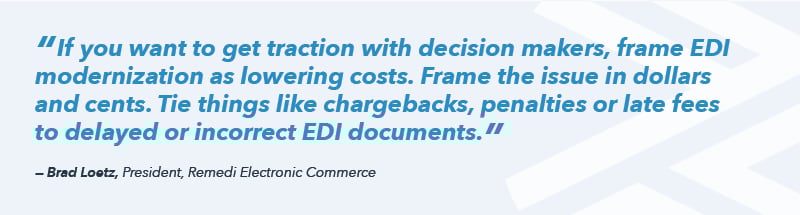
According to Remedi President Brad Loetz, “If you want to get traction with decision makers, frame EDI modernization as reducing risk, lowering costs, and better use of scarce talent, not just the latest and greatest technology.”
Also, Loetz adds, “Don’t get trapped in the weeds of technical jargon and specs. Frame the issue in dollars and cents. Tie things like chargebacks, penalties, or late fees to delayed or incorrect EDI documents.“
Once decision makers see why modernization is crucial, they can move forward. The next step is picking a tool that offers the visibility and automation your enterprise needs to compete.
What Are Some Examples of Modern EDI Tools that Offer Visibility?
Several providers of modern EDI tools offer real-time visibility through unified dashboards, API dashboards, and proactive alerts.
Let’s look at a short list of software titles, among many, from leading providers that are known for these features (full disclosure, Remedi is a reseller partner for IBM and Cleo).
IBM Sterling B2B Integrator: IBM describes Sterling Integrator as a unified gateway for B2B and EDI workflows and communications. While not a cloud-only solution, it can be deployed in the cloud. When coupled with the Remedi Framework, it allows EDI and B2B support staff to easily trace, correct, and reprocess disrupted transfers. Framework also gives non-IT users visibility to EDI data in a human-readable form.
IBM uses webMethods for managing EDI partner interactions and protocols like AS2 and offers ITX (Integration Transformation Extender) for core data transformation and validation of EDI message content.
Cleo Integration Cloud: Cleo is all-in on its hybrid EDI and API platform. The Cleo Integration Cloud features customizable dashboards that provide real-time visibility into transactions and errors. The dashboards enable data-driven decision-making and rapid issue resolution.
Boomi: Boomi offers an integration platform as a service (iPaaS). Its primary distinction is enabling end-to-end trading network visibility through a one-stop dashboard and API-first connectivity. It promises to help streamline supply chains and provide real-time insights to optimize efficiency.
SEEBURGER Business Integration Suite (BIS): SEEBURGER touts BIS as a single, modular, and AI-assisted platform that connects all applications, people, and processes—spanning B2B/EDI, API, and MFT—across cloud, hybrid, or on-premises environments.
Should You Engage a Company Like Remedi to Support Your EDI Modernization?
Companies with in-house teams that have enough time and experience should use their internal resources. They can manage the migration because they know their trading partners, maps, and custom connections.
Moving to a modern tool, even with solutions from the same provider, takes careful planning. As well as a system architect to ensure critical connections stay intact.
Who should engage outside consultants? Companies facing tight deadlines, staffing limits, limited experience with a new tool, or outside pressures. Examples include implementing new architectures or integrating APIs.
Using outside support in such scenarios allows project owners to combine internal knowledge with external consultants. Lastly, consulting SMEs add value and speed the process via deep integration tool experience with a variety of customers.
Conclusion
Legacy EDI systems, such as Gentran: Server for Windows, can be quite stable. They’re also like rotary phones: Limited to doing one thing well. While we still support customers who rely on Gentran to exchange their EDI documents, legacy EDI systems weren’t built for visibility, scalability, or modern connection/integration requirements.
On the other hand, modern EDI platforms offer:
-
Real-time visibility
-
API integration and management
-
Cloud-based deployment
-
AI capabilities in their development roadmap
-
User-friendly (i.e. non-IT user) dashboards for access to real-time insights that support better decision making
-
Lower costs and easier scalability
Making a solid case for modern EDI requires framing the investment of time and resources in terms of risk mitigation, cost control, and talent utilization.
If the risk and costs from your legacy EDI system are outweighing its benefits, let’s talk. We’ve likely assisted companies like yours in modernizing EDI systems. We do this without disrupting operations or important trading partner relationships.
Other Blogs in the Integration Resilience Series:
How EDI Managers Can Meet Pressure to Deliver Results Without Adding Headcount
What is Failure to Deliver Syndrome (FTDS) and How Can You Avoid It?
How EDI Teams Support Efficient Platform Migrations and Revenue Growth
FAQs
Q1: What are the biggest risks of staying on a legacy EDI system?
A: Poor visibility into transactions leads to slower error detection and higher manual support costs. These issues hurt real-time decision-making and profitability. They also lack modern integration capabilities like ground to cloud and cloud to cloud integration.
Q2: How does limited visibility in our legacy EDI system put us at risk?
A: Limited visibility can mean errors, delays, and failures. These issues often surface only after they have affected customers or trading partners. Without real-time dashboards or automated alerts, teams lose critical time diagnosing issues. This can lead to higher support costs, chargebacks, and customer dissatisfaction.
Q3: How do modern EDI platforms reduce manual work?
A: They use real-time dashboards and automated error handling. And they replace ad hoc scripts with pre-built connectors. This creates standardized workflows for easier management.
Q4: Do APIs replace the need for EDI?
A: No. EDI is a vital element in supply chains. Modern platforms now include API support alongside EDI. The goal is real-time data exchange, not to replace EDI.
Q5: How do I know if I need outside help with EDI modernization?
A: If you're facing tight deadlines, skill gaps, or new tasks like cloud migration or API integration, consider bringing in an experienced integration partner. Trial and error can be risky when time is short.
Sources:
https://www.remedi.com/no-form-what-is-edi-deck
https://resources.cleo.com/video-cleo-integration-cloud
https://www.remedi.com/remedi-framework-for-ibm-b2b-integrator