

Companies add new applications as they grow. Each one may solve a real need in sales, finance, HR, operations, or customer service. But when those tools don’t communicate, you get data silos, bottlenecks, and duplicated efforts. Enterprise Application Integration (EAI) lets applications automatically share information without human involvement.
This article is the third in our four-part series, The Modern Integration Mix. We’re exploring how EDI, MFT, EAI, and APIs serve distinct but complementary roles in today’s integration environments.
At the end of this article, you can find links to the other articles in the series.
First, let’s define EAI.
What Is Enterprise Application Integration?
IBM defines EAI as the process of connecting separate systems and applications. EAI often uses middleware and APIs to help those systems work together.
EAI is not one product or platform. It is an approach to linking applications and the processes they support. An EAI solution may connect an ERP with CRM, accounting, HR, warehouse, e-commerce, or other systems.
To do that, EAI can move, transform, route, and sync data. It can also apply business rules and coordinate a series of actions. This lets separate applications take part in the same process without forcing the company to replace them with one large system.
To understand how EAI can streamline common business processes, let’s consider what happens when a company hires a new employee.
How Does EAI Break Down Application and Data Silos?
Without EAI, onboarding for new hires can be messy. There's often duplicate data entry, which wastes time. This leads to long administrative delays and gives new hires a poor first impression.
It can look something like this:
Copy, Paste and Repeat: An HR specialist must manually copy information from the Applicant Tracking System and type it into the core HRMS. Then they repeat this exact same data entry into the payroll system, the benefits portal, and the company directory.
Multiple Tickets, Duplicate Steps: HR has to file several IT helpdesk tickets to request hardware and software. From there, an IT administrator has to manually open individual admin consoles for every single tool the new hire will need. The tools used can vary by organization. They may include Active Directory, Google Workspace, Microsoft 365, Slack, and Zoom.
Compounding Risk of Human Error: Entering the same name, address, and Social Security number in five systems can lead to typos. A misspelled last name in the payroll system, but not in the identity provider, causes compliance and access problems immediately.
In the meantime, the new hire spends much of their first week waiting for IT to issue logon credentials or their new laptop. When they do get access, they receive an email with a long bulleted list of separate links.
Worse, the manager who has long-delayed real work for their new hire to begin has no visibility into their onboarding status.
With EAI, the process looks quite different.
That’s because EAI acts like an invisible digital courier to share approved employee data with the applications that need it. Once HR marks a candidate as “hired” in the HRMS, EAI starts the next steps. It also triggers onboarding tasks, so there's no need for manual data entry.
According to Boomi, this type of HR integration is a method to keep employee records updated across HR, payroll, benefits, and more. It also ensures new hires get the info and access they need from day one.
EAI eliminates much of the delays as well as the admin busywork and potential for mistakes that come with it.
How Does EAI Work Alongside EDI, MFT, and APIs?
EAI can use several methods to connect internal applications. For example, Red Hat cites capabilities such as APIs, messaging, event streams, orchestration, and data transformation.
EAI does not compete with the other parts of the modern integration mix. It often coordinates them.
In practice, EAI might use an API to check stock in real time. It might then send order data to an ERP, trigger MFT to move a batch file, and pass an EDI purchase order to a supplier. The business process shapes the mix.
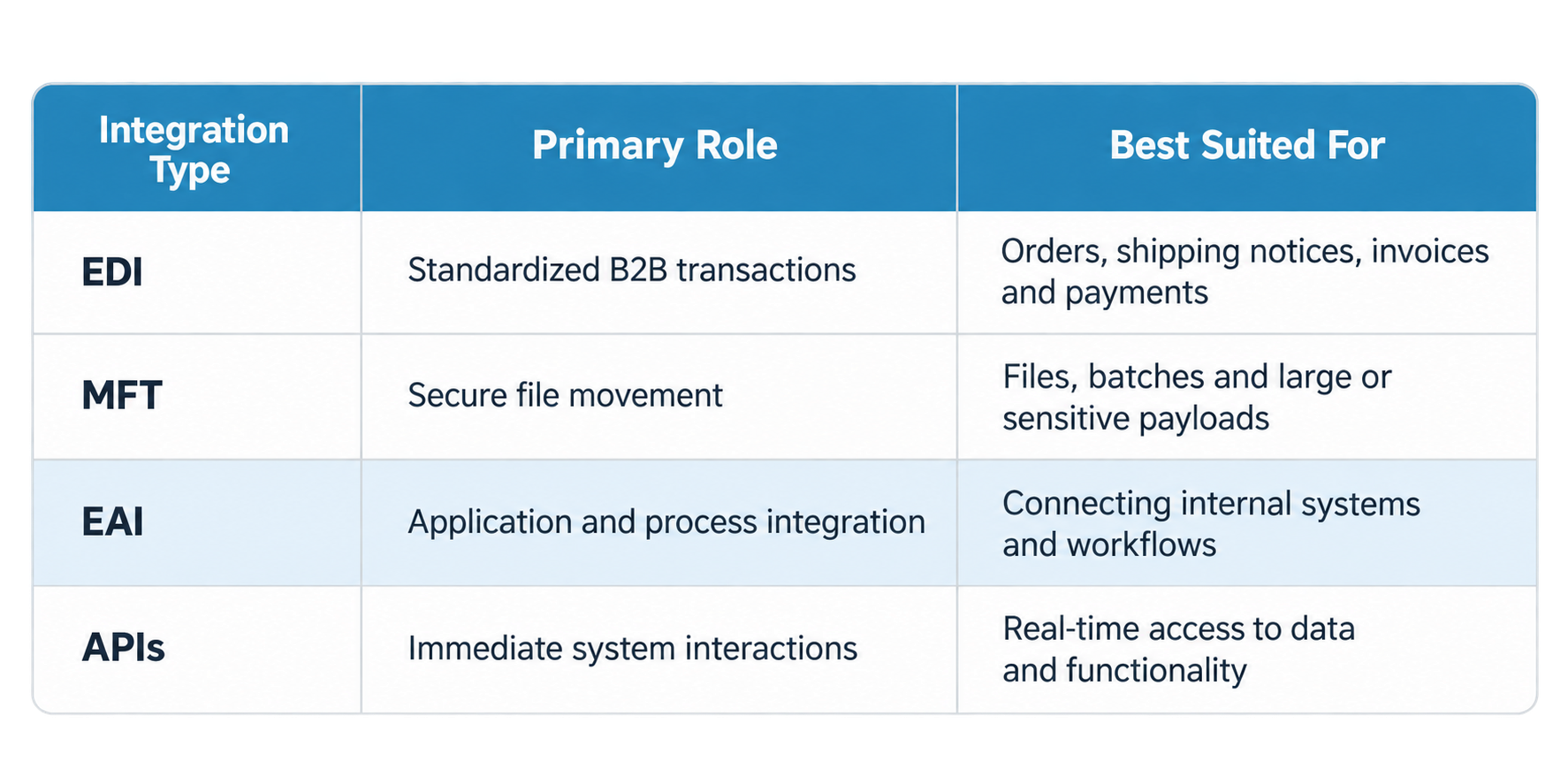
EAI connects internal applications and coordinates the data and workflows that cross them.
Where Does EAI Belong in an Integration Strategy?
EAI belongs where an important process or data flow crosses application boundaries. It is especially useful when teams re-key data, work from conflicting records, or struggle to trace failed handoffs.
EAI can simplify internal processes and also open new ways to enhance the customer experience. EAI connects different systems, making retail an omnichannel experience.
This change has transformed how supermarket chains engage with customers. Customers now shop online for groceries and can either pick them up curbside a few hours later or have them delivered.
EAI makes this kind of shopping convenience possible. It connects the ecommerce platform, the store’s inventory system, the physical location, and the employees who gather items for customers.
EAI still requires sound governance. Teams need clear ownership, useful monitoring, secure access, and documented data rules. They must also decide which system owns each piece of shared data.
Point-to-point connections may work when only a few systems must communicate. As the environment grows, those direct connections can become hard to change and monitor. AWS explains that shared integration methods can cut down on point-to-point links. However, each method has its own trade-offs.
The goal of EAI is not to connect every application. It is to break down the silos that slow the processes the business depends on most.
Where Can I Get Enterprise Application Integration Support?
Contact Remedi for help assessing, modernizing, or supporting your application integration capabilities. We also offer qualified consulting and platform support resources.
Links to Series Articles:
https://www.remedi.com/blog/the-modern-integration-mix-why-edi-still-runs-global-supply-chains
https://www.remedi.com/blog/the-modern-integration-mix-where-mft-belongs
About Us
Remedi helps customers succeed with the platforms they prefer, from IBM, Cleo, Microsoft, 1 EDI Source, SEEBURGER, Boomi, OpenText, as well as custom and legacy solutions.
FAQs
1. What is enterprise application integration?
Enterprise Application Integration connects separate business applications so they can exchange data and take part in shared business processes. EAI may use middleware, APIs, messages, events, or files to connect the systems.
2. Is EAI the same as middleware?
No. EAI is the broader approach to connecting enterprise applications and processes. Middleware is software that can provide the routing, transformation, messaging, and orchestration needed to support EAI.
3. How does EAI break down data silos?
EAI lets applications exchange and synchronize data. This reduces the need for isolated records, repeated data entry, and manual handoffs between departments and systems.
4. Is EAI the same as an API?
No. An API provides a defined way to request data or functionality from an application. EAI may use APIs as part of a wider process that connects several systems, transforms data, applies rules, and coordinates actions.
5. When does a company need EAI?
A company may need EAI when important processes cross several applications and disconnected systems cause duplicate work, conflicting data, delayed updates, or failed handoffs. The need often grows as the company adds more specialized applications.