

EDI Mapping Best Practices Defined
EDI mapping best practices are the standards and processes that define how your system translates data between your internal formats and your trading partners' requirements. When mapping is done well, transactions flow cleanly. When it's not, errors accumulate quietly until something breaks.
By the time an EDI mapping issue is identified, it’s usually already caused failed transactions, partner complaints, and chargebacks.
Most of these failures are preventable, and the patterns behind them are consistent. Understanding where maps break down is the first step to keeping them from breaking down on you.
Why EDI Mapping Errors Are So Hard to Catch
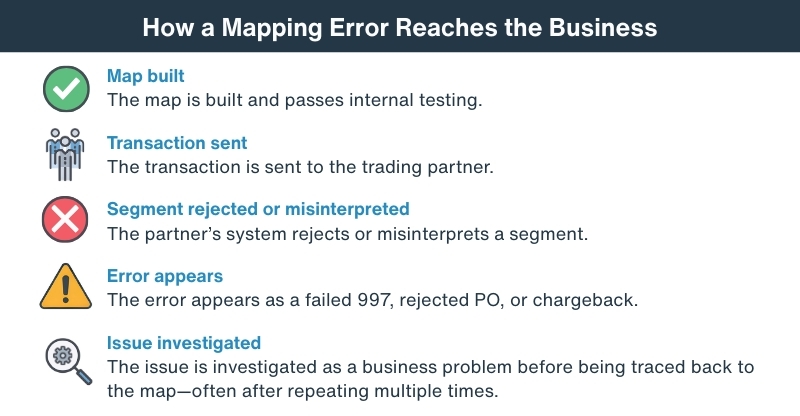
A map can pass testing and still fail in production. Testing environments rarely replicate the full range of real partner data, so edge cases and partner-specific quirks that only surface in live transactions stay hidden until they don't.
When something goes wrong, it surfaces as a rejected transaction or a chargeback in accounts payable, not as a mapping error. Tracing the failure back to a specific segment or conditional takes time, and in high-volume environments the error has usually repeated dozens of times before anyone finds the source.
The most common culprits aren't exotic. Hardcoded values that work fine until a partner quietly updates their spec are a frequent source of failures, as is missing conditional logic for fields that are optional in the standard but required by a specific retailer.
The Mapping Mistakes That Keep Coming Up
Remedi's consultants work inside client environments on map builds, audits, migrations, and error resolution. The mistakes they see most often cluster around the same gaps and compound when left alone.
Mapping to the Standard Instead of the Partner Guide
Every trading partner has an implementation guide that goes beyond the transaction standard. It specifies which fields are mandatory in their system and which code values they actually accept. The standard tells you what's possible. The implementation guide tells you what that specific partner will reject if you miss it.
Mapping to the standard and assuming it covers the partner is one of the most reliable sources of chargebacks. A field marked optional in X12 may be required by a particular retailer, and a code value that's technically valid may not be one their system recognizes.
Skipping Map Documentation
Undocumented maps work fine until the person who built them is no longer around, at which point new team members spend hours reverse-engineering business rules that should have taken minutes to look up.
When a partner updates their spec and the map needs to change, no one is sure what the original logic was trying to do.
Documentation doesn't need to be elaborate. Field-level notes and a log of the business rules built into the map are usually enough. The time it takes to write that down at build is a fraction of what it takes to reconstruct it later.
Treating Platform Migration as a Direct Translation
When you migrate maps from Gentran to IBM Sterling B2B Integrator, or from any legacy platform to a modern one, you're moving to an environment with different handling for loops, qualifiers, and conditional logic. A map built around the quirks of the old platform may not behave the same way on the new one, even if the EDI output looks identical on paper.
Teams that treat platform migration as a copy job often find the gaps in production, not testing. Planning it as a redesign, where you review each map for platform-specific logic rather than assuming a one-to-one transfer, is how you catch those issues before they reach your partners.
Testing with Partner-Supplied Sample Files Only
Trading partners typically provide sample transaction files for testing. Those files represent the happy path. They don’t show when optional segments are used incorrectly or when upstream manual data entry introduces inconsistencies.
Testing with production data, anonymized where needed, gets you much closer to what your environment will actually see. If the partner is new and you don't have that data yet, build test cases that deliberately probe the edge cases in their implementation guide.
Building Maps Without Input from Operations
Maps built purely from the technical spec often don't reflect how the data gets used once it arrives. Operations teams know which fields actually matter downstream and where data quality problems tend to originate. Getting that input before you build catches a category of errors that technical review alone won't surface.
What Good Mapping Practice Actually Looks Like
Teams that avoid repeat mapping problems tend to treat maps as living documents, not one-time deliverables.
A few consistent habits make a significant difference over time.
- Validate against partner guides, not just the transaction standard. Get the implementation guide from each trading partner and build to their specific requirements. Flag discrepancies between the guide and the standard before you start mapping.
- Build in conditional logic for edge cases. Optional fields become required in specific scenarios. Map those conditions explicitly rather than leaving them to chance.
- Document at build time. Field-level notes and a log of the business rules built into the map take minutes to write when you're in the map and hours to reconstruct later.
- Use production-representative data in testing. Anonymized production data gets you much closer to what the environment will actually see than a partner-supplied sample file.
- Set a map review cycle. Partner specs change. Review your maps against current implementation guides on a regular cadence so they don't drift out of compliance quietly.
- When migrating platforms, plan for redesign. Carry over the business logic, not the literal structure of the old map. What worked on the old platform may need to be rebuilt for the new one.

When You're Behind: Clearing a Mapping Backlog
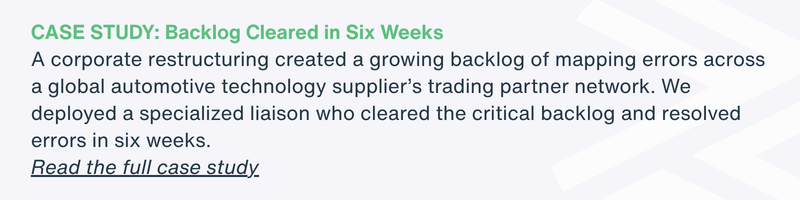
Backlogs don't usually happen because a team is doing something wrong. They tend to follow an acquisition that doubles the trading partner network, or a platform migration that puts every existing map back in the queue at once.
The signs are recognizable: Partner onboarding requests pile up, manual workarounds fill the gap, and error volume climbs as the queue grows. When the backlog gets large enough, it slows new business. Partners waiting to go live means delayed revenue.
To get out from under a backlog, you need a few things working together. Automated conversion tools can cut high-volume legacy map migrations from months to weeks.
Surge staffing from a co-sourcing partner adds skilled capacity for the duration of the project without adding headcount you won't need once the queue clears. Triaging by partner revenue and transaction volume helps sequence the work so the highest-impact onboarding moves first.
Prevent EDI Mapping Errors Before They Escalate
Are your maps overdue for a review, or are you looking at a backlog that keeps growing?
Remedi’s consultants have been working inside EDI environments like yours for more than 30 years. If you’re not sure if you need a map audit, surge capacity for a migration, or ongoing managed support, we can help you figure out where to start.
Contact Remedi today to talk through your EDI mapping approach and identify gaps before they reach your trading partners.
Frequently Asked Questions
What causes most EDI mapping errors in production?
The most common source is mapping to the transaction standard rather than the specific partner's implementation guide. Hardcoded values are a close second: they work until a partner updates their spec, and the failure only surfaces when a live transaction hits a value the map no longer handles correctly.
How do I know if my maps need a review?
Recurring transaction failures with a specific trading partner are the clearest indicator, especially if the errors don't have an obvious cause. Maps that haven't been reviewed or documented since the analyst who built them left are also overdue. If you're planning a platform migration, a map audit beforehand is worth the investment.
What's the difference between mapping for a standard and mapping for a trading partner guide?
The EDI standard (X12 or EDIFACT) defines what a transaction set can contain and how it's structured. A trading partner's implementation guide defines what that specific partner actually requires in practice: which fields are mandatory in their system, which code values they accept. The standard describes the range of possibilities. The guide tells you what the partner will reject if you get it wrong.
How long does it take to migrate maps to a new platform?
Timeline varies by the number of maps and whether you use automated tooling. Manual migration of a large map library typically runs six to nine months. Automated conversion tooling can bring that down to one to two months for many environments. In both cases, the single biggest factor is how well the original maps were documented and how different the new platform's conditional logic is from the old one.