

When it comes to pre-internet technology, EDI is the Godzilla of the supply chain universe. After all, you can’t kill something that keeps on delivering the goods. But platforms developed in the 1990s are no match for competitors who are adopting modern data exchange solutions.
EDI still powers the bulk of the world’s B2B transaction traffic (e.g., orders, invoices, ASNs) for good reason. It’s universally accepted across all industries. It’s secure. And it’s stable.
But as supply chains face tariffs, rapid market changes, and evolving connectivity and messaging requirements of business partners, traditional integration approaches can become bottlenecks.
This article explains why legacy integration stacks can't keep up with the modern requirements of today's supply chains. They struggle to provide the speed, flexibility, and visibility that are now essential. And it illustrates how EDI continues to play a central role in modern integration infrastructure that delivers the agility organizations need in the real-time digital economy.
This is one of several articles in our series on Integration Resiliency. You’ll find links to the other articles at the end.
What is the Meaning of “Legacy Integration Stacks"?
When we say “legacy integration stacks,” we refer to old on-premises purpose-specific EDI translators and point-to-point middleware. These tools connect internal systems (ERP, WMS, etc.) to trading partners via scheduled batch file exchanges and hand-coded maps. These systems are still widely used because they reliably handle large volumes of transactions.
Legacy integration stacks continue to play a key role in today’s supply chains. But they can also limit scalability, communication flexibility, and fail to support modern integration techniques and requests. In manufacturing or retail, legacy EDI often involves on-premises EDI gateways.
These gateways may process X12 or EDIFACT documents according to some execution schedule, but often are unable to do so in real time. They also tend to require lots of manual steps for tasks such as partner onboarding and error resolution. Also, these stacks often rely on individual connections or extra solutions rather than present as a unified platform.
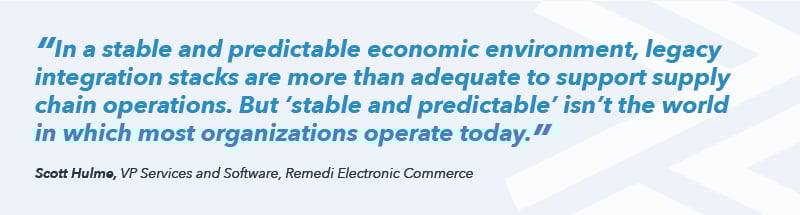
“In a stable and predictable economic environment,” explains Scott Hulme, Remedi VP of Software and Services, “legacy integration stacks are more than adequate to support supply chain operations. But ‘stable and predictable’ doesn’t describe the world in which most organizations operate today.”

Why Legacy Integration Struggles When Supply Chains Pivot
Disruptions like the COVID 19 pandemic and recent tariffs can call for rapid trading partner or channel shifts. These shifts stress systems that aren’t built for high-speed change velocity. Change velocity is the speed at which your team has to make integration updates when something in the supply chain shifts.
For example, scrambling to onboard a new supplier to fill a critical order or support an integration request with a new cloud application.
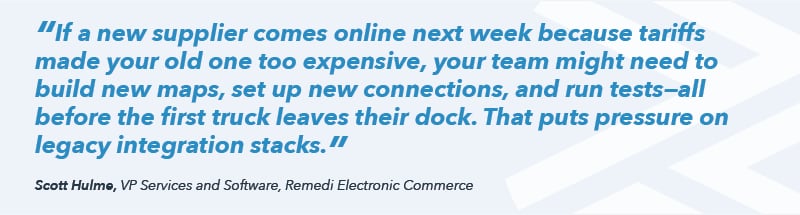
Legacy integration stacks often lack real-time exchange, automated onboarding, and agile error diagnostics, making pivots slow and hampering production. “In practice,” says Hulme, “this means that if a new supplier comes online next week because tariffs made your old one too expensive, your team might need to build new maps, set up new connections, and run tests—all before the first supply order can be executed.”
What Does Modern EDI Look Like?
Modern EDI is not EDI replaced by APIs or another data exchange method. Modern EDI is EDI that works within unified platforms. These platforms also manage APIs, managed file transfer (MFT), real-time monitoring, and partner lifecycles.
These platforms combine integration logic, protocols, and visibility into one governance layer. Many vendors call this an integration fabric. Their key characteristics are:
Hybrid integration: EDI for structured document exchange; APIs for real-time interactions
- MFT as the backbone for automated, secure file movement across systems and partners
- Centralized dashboards for visibility, exception handling, and analytics
All of that said, modern EDI is more than technology. It also requires operating discipline.
Why Operating Discipline Matters to Modern EDI
Operating discipline means consistent processes and roles within an organization. These help an integration platform provide value. In production settings, this means:
- Clear onboarding steps
- Escalation paths for exceptions
- Defined ownership for partner onboarding
- Measurable KPIs, like onboarding cycle time and exception resolution time
Operating discipline sets the path and limits for efficient integration. Which in turn, allows organizations to execute against their business strategies and growth plans.
Put another way, modern platforms make a variety of integration capabilities possible. But without disciplined processes and role clarity, organizations will continue to fall short of their KPIs. Examples of operating discipline include documented onboarding templates, test plans, rollback plans, and escalation playbooks.
And last but definitely not least, the backbone of operating discipline: Hiring and training models augmented when needed by external SMEs to ensure sustainable operations.
Conclusion
If tariffs, other supply chain uncertainties, or modern integration requests are pushing your business to pivot faster than your B2B integration stack can pace with, you’re not alone. But it also might be time to rethink both the technology and the discipline that runs it. If you’d like a practical assessment of where your bottlenecks are and how to remediate them without disruption, reach out here to book a consult.
Other Blogs in the Integration Resilience Series:
How EDI Managers Can Meet Pressure to Deliver Results Without Adding Headcount
What is Failure to Deliver Syndrome (FTDS) and How Can You Avoid It?
How EDI Teams Support Efficient Platform Migrations and Revenue Growth
What Are the Risks of Legacy EDI Systems?
How to Modernize B2B Integration Stacks while Managing The Challenges Involved
FAQs
Q1: What is a legacy integration stack?
A: Legacy integration stacks refer to older, mostly on-prem integration setups where EDI translation, file transfer, mapping, and monitoring are handled through a mix of aging software, batch jobs, scripts, and manual trading-partner onboarding.
Q2: What does modern EDI mean?
A: Modern EDI means EDI is still used for core B2B document exchange, but it’s managed within a broader integration platform that also supports APIs and governed file exchange (MFT). That solution may be deployed on-premises, in the cloud, or via hybrid hosting.
Q3: Why does modern EDI require more than new software platforms?
A: Even the best platform won’t deliver agility without operating discipline. Operating discipline is the day-to-day process rigor that makes integration work reliably while still changing quickly when the business pivots. It requires the right staff (either internal, external, or a mix), defined steps, roles, escalation paths, and KPIs.
Q4: If EDI is so durable, why modernize?
A: The issue isn’t EDI itself. It’s how organizations implement and manage EDI in response to market shifts, tariffs, new customers or suppliers, new logistics partners, and new selling channels. Modernization reduces the time and risk involved in adapting maps, onboarding partners, and monitoring transactions in an economy that expects real-time agility.
Q5: What does a practical “maturity model” for EDI modernization look like?
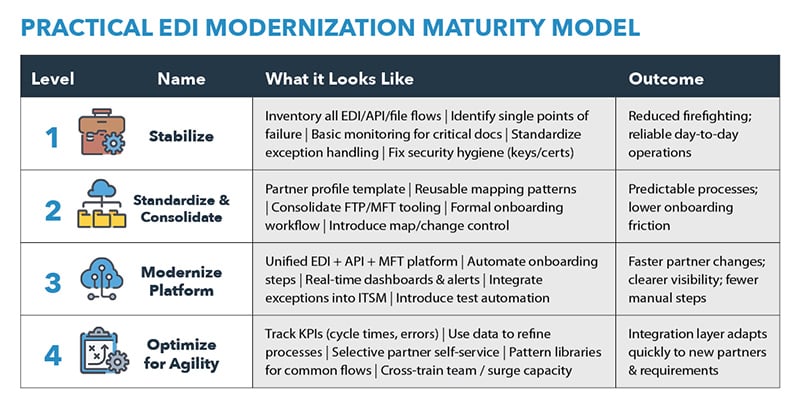
A: A practical maturity model starts by stabilizing your current flows, then standardizing partner onboarding and change control, and finally, modernizing your platform to support EDI, APIs, and governed file exchange with shared visibility. The goal is an integration stack that can pivot to new partners and adapt to new requirements with minimal disruption.
Sources:
McKinsey & Company — Supply Chain Risk Survey
https://www.mckinsey.com/capabilities/operations/our-insights/supply-chain-risk-survey?utm_source=chatgpt.com
IBM — What Is EDI Integration?
https://www.ibm.com/think/topics/edi-integration?utm_source=chatgpt.com
Cleo — Supply Chain Stories (Part One)
https://www.cleo.com/blog/supply-chain-stories-part-one?utm_source=chatgpt.com
Boomi — Platform Capabilities Overview
https://boomi.com/platform/#:~:text=Platform%20capabilities
Remedi — EDI, MFT, EAI, and API Solution Summaries
https://www.remedi.com/solutions-remedi-edi-mft-eai-and-api-solution-summaries