

Most EDI/B2B integration platforms do their job well. Most of the time, the data flows between applications, customers, suppliers, and trading partners so reliably that no one has to worry about it. But even the best integration platforms can face higher risks when changes occur around them.
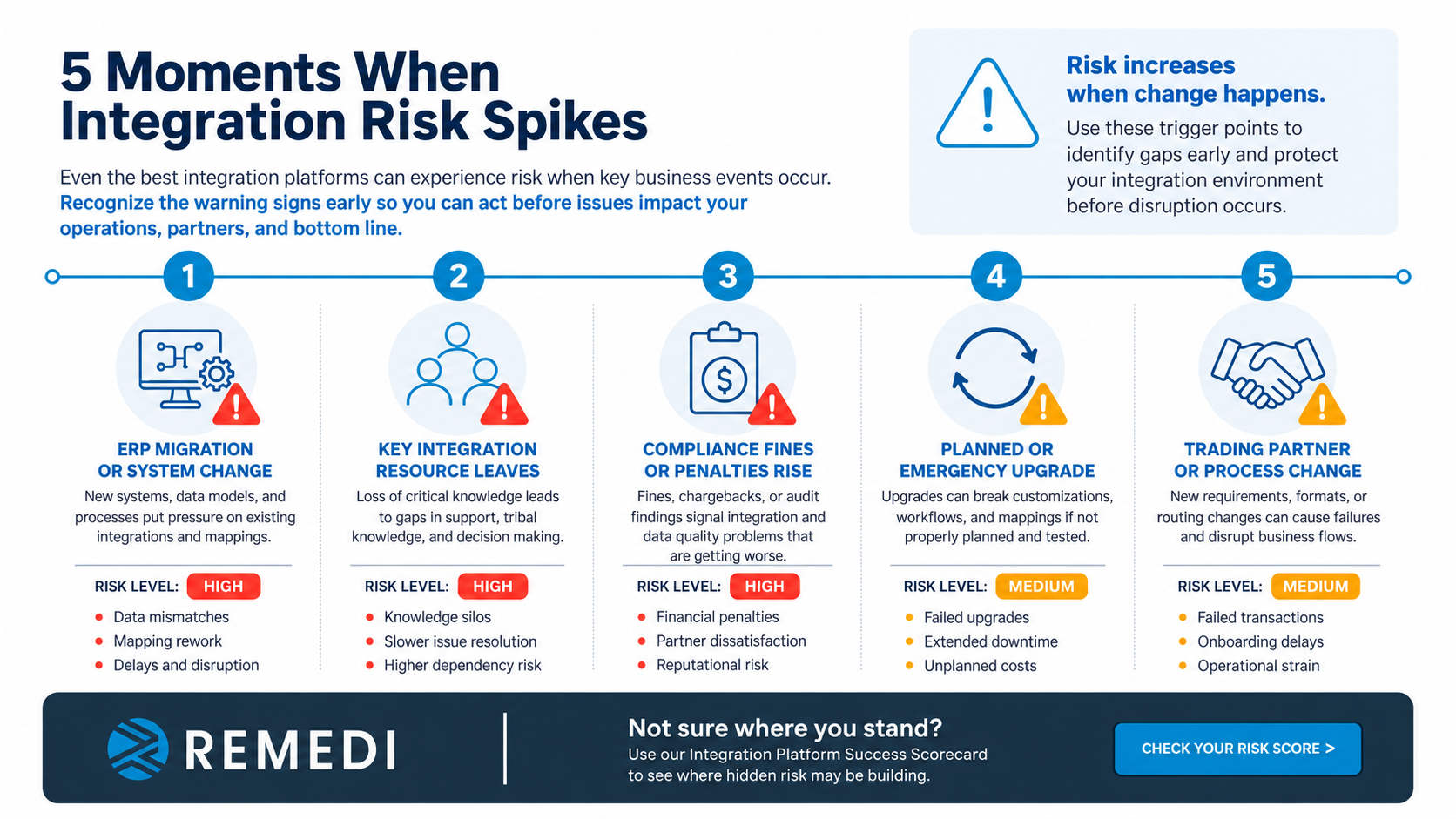
An ERP migration introduces new data structures. A key integration resource leaves. Chargebacks start appearing. An upgrade changes underlying technology. A trading partner sends a new requirement.
These events don't guarantee a problem. However, they do create moments when gaps in your integration environment are more likely to show up. Here are the top five moments when integration risks can spike.
1. ERP Migration or System Change
ERP, WMS, TMS, CRM, and other business system changes rarely happen in isolation. They can add new data models, field requirements, and validation rules. Also, they can change workflows and processing logic. These changes directly impact existing integrations and maps.
An integration that has worked well for years can suddenly cause issues. You may notice issues like data mismatches, mapping rework, and testing delays. Also, there could be problems with order-to-cash and procure-to-pay processes.
The best time to identify those dependencies is during planning—not during cutover.
Involving EDI/B2B integration owners early helps the team stay on track and avoid issues. Integration process owners can also:
- List touchpoints
- Find affected trading partners
- Align testing schedules
- Check key business flows
Related reading: EDI/B2B Support for Successful ERP Migrations and Upgrades: Best Practices
2. A Key Integration Resource Leaves
Integration environments can hold years of a company's so-called tribal knowledge. They include maps, workflows, partner needs, exceptions, and workarounds. This knowledge has built up over many years.
Unfortunately, some of that knowledge may exist primarily with one or two people.
When a key analyst, mapper, or developer leaves or is unavailable, support gaps can appear quickly. Error resolution slows. Decisions take longer. Undocumented dependencies suddenly matter.
This is more than a staffing issue. It’s an operational continuity risk.
The good news is that timely documentation can help stop bottlenecks. Cross-training can plug skills gaps. Backup coverage, from inside or outside, is essential. Taken together, these steps can help keep one departure from disrupting the whole integration environment.
Related Remedi reading: Hybrid EDI Staffing: The Practical Way to Keep Your Integration Team Running Strong
3. Compliance Fines or Penalties Rise
Chargebacks, SLA penalties, rejected transactions, and audit findings are rarely just accounting problems. They can be signals that something upstream in the integration environment needs attention.
A failed ASN. An invoice that doesn’t meet a customer’s requirements. Incomplete monitoring. A recurring data quality problem. A security or compliance control that no longer matches the environment.
When these costs begin rising, look for patterns rather than treating each occurrence as an isolated exception. Clearer transaction visibility helps spot problems. Root-cause analysis can show if financial leaks point to bigger integration issues.
Related Remedi reading: How Is EDI Compliance Related to System Security?
4. A Planned—or Emergency—Upgrade
Upgrades are necessary. They can also expose dependencies that have been quietly accumulating for years.
A platform or infrastructure change can affect many other components, such as:
- Custom business processes
- Maps
- Adapters
- Certificates
- Databases
- Operating systems
- Third-party components
- Trading-partner connections
The difference between a controlled upgrade and a disruptive one is mostly about preparation.
You must document and factor in dependencies, validate backups, and perform regression testing. Also, set up rollback procedures.
Last but not least, you’ll want to make sure the right in-house or external experts are available before, during, and after the cutover.
Thorough preparation won't necessarily narrow the margin for error. But when an emergency or an approaching support deadline drives an upgrade, it can help you avoid preventable mistakes.
Related Remedi reading: How to Regain Momentum on Stalled Migration Projects
5. Trading Partner or Process Change
Your environment doesn’t have to change for your integration risk to change.
A customer, supplier, distributor, or logistics partner can introduce a new document version. Seems simple enough. But they can also change the data format. They might update the endpoint, protocol, routing requirement, or business rule, and trigger new testing .
When any or all of these things happen, a stable integration can suddenly become the source of failed transactions, onboarding delays, or more work.
Clear change management and onboarding processes help everyone adapt. Documented partner requirements and end-to-end testing ensure smooth transitions. Good communication keeps business flows intact.
Related Remedi reading: Why Trading Partner Onboarding Fails and How to Fix It
Change Is Inevitable. Disruption Doesn’t Have to Be.
As discussed in our Integration Platform Success series, getting the most from an integration platform is about more than the technology.
Realizing ROI from integration investments also depends on how well organizations document, monitor, support, and maintain the environment. Like the organizations they support, these environments must adapt as business needs change.
Not Sure Where You Stand?
The five moments above offer a simple way to know when it makes sense to look more closely. But they’re only part of the picture. Rate your risk with Remedi’s Integration Platform Success Scorecard.
This easy interactive tool helps you assess your environment in just minutes. It focuses on the key factors that lead to long-term success in integration. The final results show you where risk may be building.
In the meantime, you can click on the graphic below to download our quick reference guide that identifies each risk moment:
About Us
Remedi helps customers succeed with the platforms they prefer, from IBM, Cleo, Microsoft, 1 EDI Source, SEEBURGER, Boomi, OpenText, as well as custom and legacy solutions.
FAQs
1. When should you reassess your integration environment?
A good time to reassess is whenever something significant changes around the integration environment — such as an ERP migration, platform upgrade, staffing change, rising compliance costs, or new trading-partner requirements. These moments can expose dependencies and gaps that may have gone unnoticed while the environment was stable.
2. What should you review before an ERP migration or integration platform upgrade?
Start by identifying the integrations, maps, trading partners, custom processes, certificates, adapters, and other dependencies that could be affected. Planning early also gives teams time to coordinate testing, validate critical business flows, and prepare rollback or contingency procedures.
3. How can you tell if your integration environment depends too heavily on one person?
Warning signs include undocumented processes, limited cross-training, slow issue resolution when a particular person is unavailable, and important platform or trading-partner knowledge that exists primarily in one person’s head. Documentation, backup coverage, and knowledge sharing can reduce that dependency.
4. Can chargebacks, rejected transactions, or compliance penalties indicate a larger integration problem?
Yes. When these issues begin occurring more frequently, they may point to recurring data-quality problems, mapping errors, monitoring gaps, or changing trading-partner requirements. Looking for patterns and root causes is usually more valuable than treating every incident as an isolated exception.
5. Does a stable integration platform mean your integration environment is low risk?
Not necessarily. An integration platform can be operating reliably while risk is building around it. Changes to business systems, staffing, trading-partner requirements, compliance demands, or supporting infrastructure can introduce new dependencies and expose gaps that weren’t obvious when the environment was stable.